
BOOK BLOG #11
In which I recommend a Jilly Cooper bonkbuster and investigate why I hate romance novels

tldr: why you’ll like Jilly Cooper’s Riders even if, like me, you are depressed by romance novels.
[please read in app, much better formatting experience]
Romance novels are a force to be reckoned with in this day and age. I’ve been thinking about them a lot recently.
There are many aspects of romance novels that I can get behind. For one, although it’s a genre that used to be overwhelmingly heterosexual, I think in the last couple of decades it’s welcomed a lot of diversity, including in sexuality. That seems good.


Romance novels are a socially acceptable avenue for women to consume porn—and furthermore, porn where women’s needs are prioritized. It makes sense to me that women would want that, since clearly current mainstream online pornography is focused more and more on degrading women, and sometimes children.
It’s a genre where there tends to be lightness and there’s an expectation of a happy ending. I get why people, especially now, would want that comfort. A happy ending in a book can feel like an expression of hope.
Clearly it’s a dominant genre that is still on the rise— and there’s not been enough real reporting on this, given that it’s a significant financial trend. Romance is the #1 top selling genre around the world. And women are the force behind that, as it is overwhelmingly women who read romance novels. The New York Times reported in 2024 on the fact that brick-and-mortar bookstores specializing in romance novels are opening up across the country. They have opened in big cities like Los Angeles and Brooklyn, but also places like Cleveland, Wichita, Buffalo, Anchorage, and so on. This is remarkable, in a time when for years people have been bemoaning the death of bookstores and the publishing industry more broadly.
And yet! I generally don’t like them and think a lot of them are written terribly. Okay, I said it. Here are some of the reasons I get annoyed by them.1 Let’s get into it.
THE CHARACTERS HAVE NO FLAWS. Sure, they have fake flaws. They have the kind of bullshit flaws you bring up in a job interview when the interviewer asks, “what do you think your weaknesses are?” and you say, “I just care so much that sometimes I work too hard!” Maybe the man in the romance novel is grumpy— but wait, he’s not actually grumpy. Because that would be a flaw. He’s actually just shy! That’s okay. The woman seems abrasive. No she’s not! She just loves her career, so she’s misunderstood as being brusque! Don’t worry! I do think this is a larger trend in TV, books, and just general bad writing that I’ve noticed in a post cancel culture era: as a way to avoid being offensive, writers are scared to give characters any kind of personality. This is a shame and truly idiotic.
THE CAST OF CHARACTERS IS TINY. This is a personal issue I have with the contemporary novel more broadly, which is that it is so damn lonely. The hero of the moment is one who grapples with alienation, and their journey is often extremely internal (and here I think of books I’ve really enjoyed from the last year or so like Martyr!, All Fours, Stone Yard Devotional, etc). I do like books like this, to be clear. But I also crave books that seem to be rarer nowadays— books with a huge cast of characters and a hero who is surrounded by connective tissue. Instead, contemporary novels seem to reflect the isolation of our current moment, and romance novels seem to suffer from this… but even more so. The two destined lovers are never part of a huge cast; they’re two shopkeepers in a small town (there’s a looooot of small towns in romance novels); they’re two people thrown together on a vacation; if there are other characters, they tend to be an archetype of a best friend who might as well be a cardboard cutout.
LIFE BEFORE THE TWO CHARACTERS GET TOGETHER IS SAD AND LACKING. I understand that setting up that being single is empty and emotionally unsatisfying makes the payoff all the more rewarding when the two characters then get together. But this plays into this idea that single people don’t quite exist— that life is only worth living when someone is partnered up. Which I suppose creates the very stakes of a romance novel. But why must we still be propagating this malarkey? Romance novels (and the isolation mentioned above contributes to this too) then also set up the idea that the partner is someone who will satisfy ALL of one’s needs: they are a best friend, they are a romantic partner, they are your therapist, etc.
THE WRITING ABOUT SEX IS BAD. Everybody is having simultaneous orgasms, and P in the V still reigns supreme. I won’t delve too deeply except to say that it’s so far removed from reality to be laughable.
The inevitability of two people getting together at the end as dictated by the romance novel structure simply depresses me. (As a wise friend said when I consulted her, “possibly you’re just depressed.”) Well, sure. (I just bought myself a happy lamp!) But the problem remains. The entire comforting predictability of a romance novel is exactly what I find depressing.2
End tirade and enter Jilly Cooper.
Dame Jilly Cooper is the reason I’ve been thinking about romance novels. I picked up Riders, the first book in her Rutshire Chronicles, after hearing about her death in October.
I was tickled by her obituary, interviews I read with her, and by podcast episodes about her legacy. Riders is witty and hilarious, and clearly so was Dame Jilly. I loved this exchange from a Daily Mail interview:
We reflect on the furore that surrounded Riders when it first came out. The horsey fraternity of Rutshire (based on Jilly’s Gloucestershire) was, it seems, in a permanent state of arousal. There was sex, mainly adulterous, at every opportunity and in all permutations: al fresco, in stables, bluebell woods, horse boxes.
From well-thumbed pages a generation of pre- internet teenagers gained an insight into the mechanics of an orgy; a ‘heaving anthill of legs and arms’, as Jilly described it.
Her children Felix, 47, and Emily, 44, were in their teens when the book was published. ‘Felix read the four-in-a-bed scene and said: “Mum! How do you know about these things?” and I said briskly: “I’ve got something called an imagination.”
‘Emily was lovely. She has read all the fiction I’ve written, and she came back from her boarding school [Downe House in Berkshire] and said: “Mum, your books have been banned.” I rang the headmistress and said: “Miss Farr, how do you expect us to pay the fees if you ban my books?”
‘I suppose I don’t blame her; Riders is jolly strong but I think it helped the sale of torch batteries. Lots of teenage girls were reading it under the bed covers.’ There was approbation from unexpected quarters and indignant outrage from others.
Jilly says: ‘A woman charged up to me at a literary dinner, roaring: “I’ve just read every word of your disgusting book,” and I said: “Gosh, I’m sorry.”
Riders is about, as the book cover would have it, the “hard-riding, high-living, sexy men and women who chase glamour and glory in the spectacular world of international show jumping.” (If you’re an imbecile like me, you will come over the course of the book to understand that “show-jumping” is riding horses through a timed obstacle course which includes hurdles.)
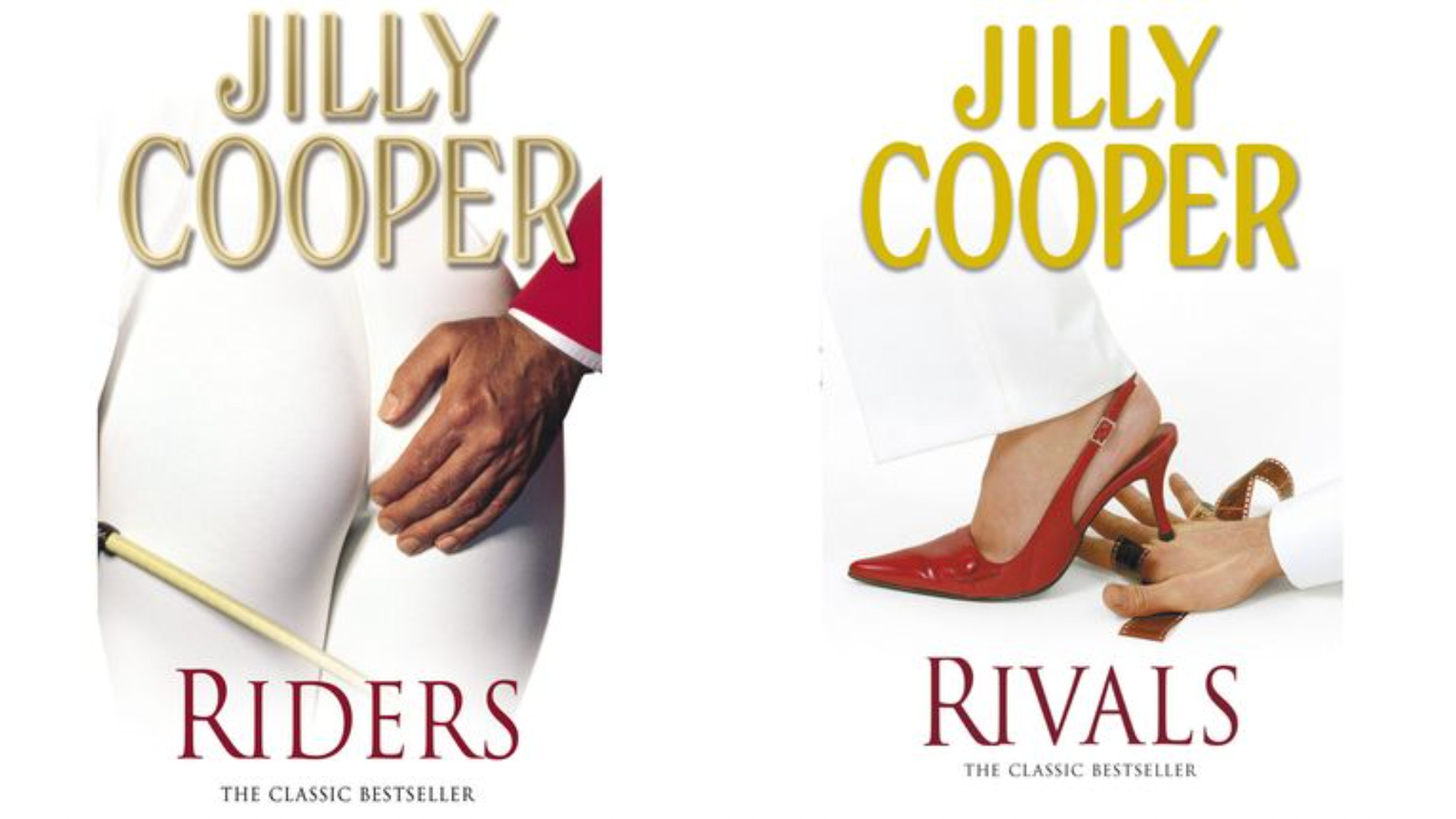
All these romance novel conventions that I’ve been complaining about — Riders breaks them all. It’s about a huge cast of totally obnoxious characters. Many of them are quite awful. J’adore! Marriage (or sex) is not the end of anything. For Dame Jilly, sex is just sex—it’s not particularly transformative, although it is fun, and it doesn’t go on for pages and pages. (Not that there isn’t quite a lot of it, there is! That’s why Riders and its sequels are apparently called “bonkbusters.”) And finally, as a bonus I think the writing, particularly the writing about people’s foibles, is quite stellar.
Riders tracks the career of Rupert Campbell-Black (a total shit) and the other main English show-jumpers, including his best friend Billy, his nemesis Jake, Jake’s protege Fenella (going on the baby name list!!!), a man inexplicably nicknamed Humpty, the team manager, a bunch of other stars, their grooms, funders, wives, husbands, and hangers-on, and assorted other riders from the international teams.
The book is a product of its time of course, and has its share of misogyny, racism, and quite a lot of fatphobia. Beauty = thinness = self-control = moral goodness. We know the formula well! At the end, one of the main show-jumpers goes back to his long-suffering wife after an affair and she’s— oh yes, lost a significant amount of weight and is suddenly seen by him in new light. Woof.
Regardless, Riders is excellent, and I highly recommend despite the sheer size of the book (fat).
Cooper became a “dame” in 2024 for her “contributions to literature and charity.” When asked how receiving damehood felt, she responded, “orgasmic,” which tracks. I adore you, Dame Jilly.
So many caveats, of course. Firstly, I haven’t read all romance novels, obviously. This is my unscientific take developed from years of being a heavy reader— which has included reading romance novels, especially the ones that have made it into the mainstream. (I also view YA romance novels as separate from the romance novel. I think YA tends to be more innovative!) I define a romance novel as a book shelved in the adult romance section at the library or bookstore.
There have been times in my life previously where I did not necessarily find this depressing! I don’t hate all romance novels! There are romance novels I’ve loved and I’m sure I will recommend them at some point. Watch this space.
I don't read that many romance novels, but my favorite is Red White & Royal Blue 😌. I can't promise it avoids allll of the pitfalls you mentioned but I do love it. Some very lovely political escapism when you need it 😶
Great read Eva. Was unaware of Dame Jilly until we stumbled across the TV adaptation of Rivals on Hulu earlier this year. I thought while watching it how fun the book must be (and will get around to reading it) My mother is and has always been a voracious romance reader (Nora Roberts is her fave, I believe). Glad to see the genre getting some love (pun intended!)