
BOOK BLOG #4
CAMPUS ROMPS and I really go on and on

CAMPUS ROMPS
Oh my god, just give me something FUN to read. I need it, desperately. I think we all do. Taking in the news, getting into fights about Ezra Klein over text, just trying to keep up with the relentless delivery of the Economist each week (do I need to cancel? It comes far too often)… the barrage of horrors being delivered into our devices, into our brains…
These three sexy campus romps are fun and a guaranteed good time. I give you my personal guarantee, for what it’s worth. Plus tis the season, at least where I live, where the mornings are nippy and that White Stripes song We’re Going to be Friends is playing in my head. These are back to school szn picks.
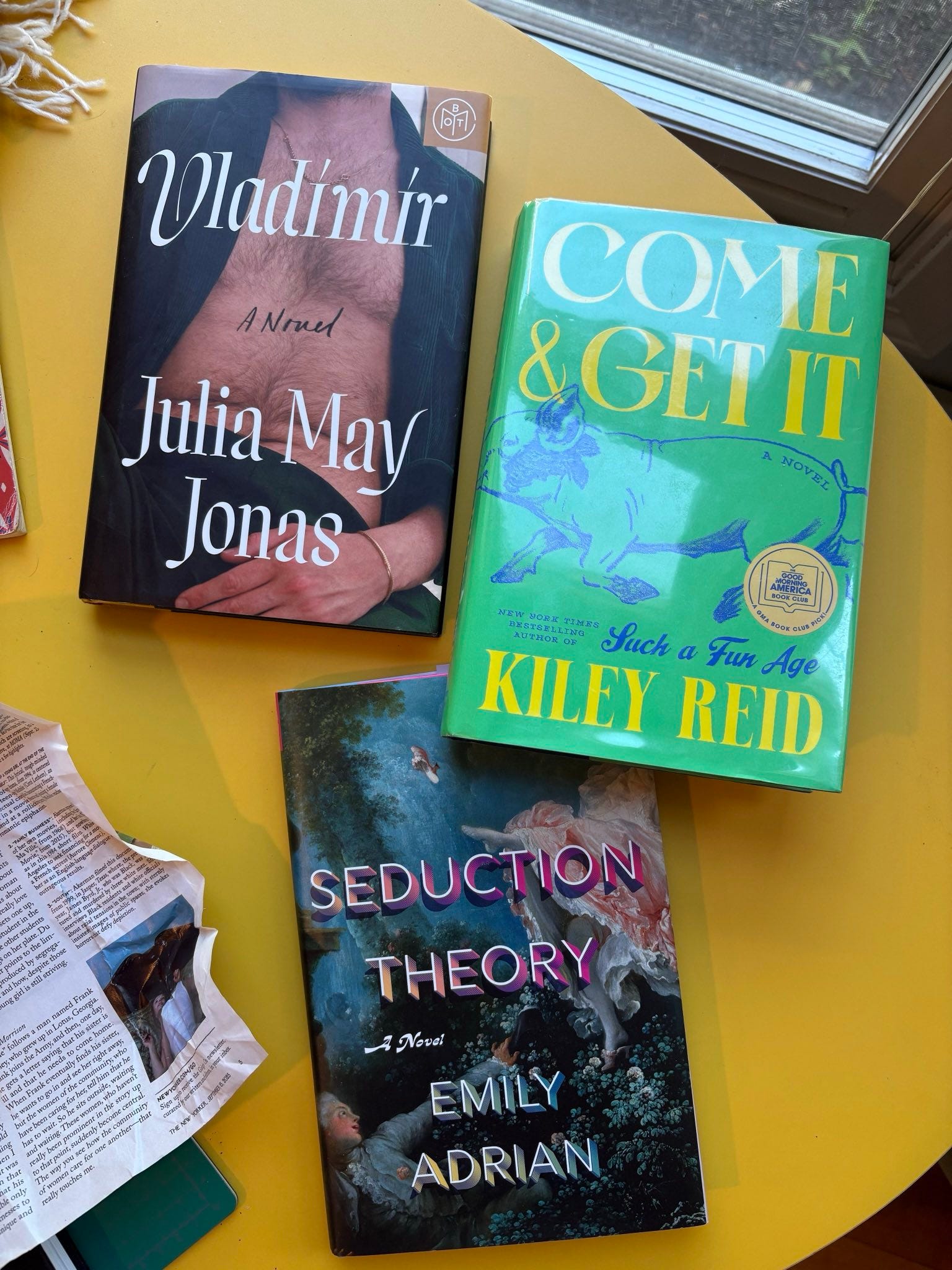
Vladimir by Julia May Jonas (2022)
Vladimir explores the life of a literature professor at a small East Coast liberal arts college. Her husband John, also a literature professor, has just been accused of sexual harassment by several students he had physical relationships with, albeit before the college formally put an anti-fraternization policy in place. (See, already, a caveat.)
In the eye of the public, the wife is always somehow at fault in these narratives. If the husband transgresses, she either knows about it (the Alice Munro archetype), enables it (the Ghislaine Maxwell), or is somehow so stupid and annoying she deserves our ire even if she seemed to have nothing to do with it. The wife is never blameless.
But in Vladimir, the unnamed female narrator would say that her husband’s affairs have nothing to do with her. How’s that? She and her husband have an open relationship, and she has had her own extramarital relationships (although not with students).
She fends off accusations from her students of her own complicity and fault with calm assurances. She begs for their understanding. But internally, she is complicit with her husband, not out of love or even loyalty, but because of a stubborn frustration with how simplistic she sees the narratives of his accusers as. She rejects the idea that the young women who got involved with him had no agency.
The narrator, a longtime academic in her mid-50s, knows just how much power the students have and that she needs to grovel before them. While her husband undergoes a faculty tribunal on his path to being cleared, she is asked to stop teaching because “students feel uncomfortable.” (This article from yesterday about the firing of a Ball State employee reminded me of Indiana’s law creating an anonymous reporting portal to allow students to tattle on perceived bias from instructors. Even decades before these portals existed, anonymous student-teacher evaluations have always had great sway in firing decisions; this I know from growing up with a mother in academia.)
Her adult daughter simultaneously dubs her father’s dalliances as “power raping” and tells her mother that if she resigns she’ll let “them” win. (The narrator is the first speaker, her daughter the second.)
“I don’t want to be teaching if people don’t want me there. If I’m making people uncomfortable.”
“It’s not about them being uncomfortable. Trust me. It’s about them winning. What will it look like if you stop? You’ll basically agree to be seen as an accomplice when you had nothing to do with what Dad did.”
“But maybe you’re right, maybe I am an accomplice.”
“Listen to me. I can call you an accomplice because you’re my mother and he’s my father and I don’t like the idea that you were telling me a lie this whole time. But if you’re an accomplice, most everyone is, right? It was common knowledge, right?”
They knew what they were getting into! They were attracted to his power! Even as she disavows her husband to her students, we are privy to her thoughts. Internally, she is his defender. To some extent, she is a product of a different time (this is shown too with her anxious relationship with her weight and her age). But she also simply refuses the easy narrative of her husband’s philanderings. There are complications, in her view. All of them were over the age of 18. The women were always the instigators, not her husband. None of their careers, she claims, were hurt by the affair. And none of them should be laid at her doorstep!
Vladimir deals with the unease and the anxiety of the post-Me-Too reckoning: did it go too far? And what, if any nuance, can there be? The students clamoring for the narrator’s dismissal because she makes them uncomfortable would say none. But of course there is.
One of the most interesting moments is when the narrator’s Black mentee, Edwina, comes to her professor’s office after avoiding her during much of the frenzy about her husband’s behavior. Edwina, who speaks first below, is dismissive of the situation, which she calls a “white woman thing.”
“I know that I would do a lot of stupid things if I felt like I was allowed, but I don’t have that privilege.” I could see that despite her best effort, tears were once again pressing against her eyes.
“Would I ever have pursued a teacher? No,” I said, “but everyone has the privilege of having experiences and making mistakes and being forgiven.”
She sat back and huffed. Hurt dimmed her expression and she took a few deep breaths to calm herself. “No, they definitely don’t.” Her mouth twisted, dismissing me.
I knew I had made a misstep. The students she was surrounded with, all these white non-scholarship kids, these kids with so much money, they could make mistakes and have them cleaned up in a way that was impossible for her. “I understand what you’re saying, but they should, right?”
“I’m confused,” she said, thought she wasn’t; she was using the word confused in the way so many of my students did, to mean they disagreed or didn’t like what one was saying. “Do you mean John should be forgiven? Or the women?”
Before the book becomes mired in the transgressions of the narrator’s husband and what it means to be the wife, our unnamed narrator has her own transgression. It is rather more interesting than his. She becomes sexually obsessed with a new hire in the department named Vladimir. He is the love object and a perfectly timed distraction in this time of great stress. Unfortunately, he is married to a brilliant, slim-hipped, mentally unstable memoirist whom the narrator envies. This is the most vehement in her line of love affairs. To expand on this is to spoil the plot, but I’ll just say that the book has a major twist more than halfway through, and then another at the end. The book morphs from a tale of transgression into a tale of punishment; its apparent inevitability, in one form or another. Transgression seems to invite punishment, if not from a formal body, then from the universe. Here, the punishment is not just an end but an opportunity for a reset. Vladimir is the narrator’s obsession, her savior, quite literally, and also her punishment. Vladimir is an era.
Come and Get It by Kiley Reid (2024)
Come and Get It is set in 2017 at the University of Arkansas. A different campus vibe, but a similar interest in the ethical microcosm of the college setting. (Fittingly, by the way, Julia May Jonas reviewed Come and Get It for the NYT.) Kiley Reid’s first novel Such a Fun Age, was similarly thought-provoking. Those lofty philosophical, political, moral values that you might espouse—what happens when they are tested?
Agatha is a visiting professor who has fled to Fayetteville for a yearlong appointment at U of A after a gnarly break-up with her wife. She sets out to write nonfiction about college-age women’s views on weddings.
Millie is a resident assistant whose finances are precarious, which sets her up to take cash from Agatha for facilitating a one-time listening session on weddings and marriage with three of her residents, and then later letting Agatha come listen to three different women in the suite next door to hers through the thin walls. Agatha’s project morphs into a book about money and class, rather than weddings, reflecting the college students’ true interests. Millie, who is Black, is also Agatha’s interpreter for the barrage of micro-aggressions that seem to dribble effortlessly out of her residents’ mouths.
Millie is out of place, a senior trying to graduate at twenty-four after leaving school for a year to help out her sick mother. She is also obsessed with money and class, albeit differently than the women Agatha is primarily interested in, who are throwing money around and being supported by their parents. Millie is saving up for a house and looking forward to her life after babysitting college residents. Agatha is financially secure because of a book she wrote on grief. Money had been a consistent tension in her relationship with her wife, Robin. Robin, a dancer, made much less than her, and Agatha paid for almost everything.
Come and Get It lays bare the unspoken interactions about money we have on a daily basis, whether negotiating with a partner or friends, about what’s feasible, and the imbalance when what’s feasible is different for each person. The anxiety of doing the math all the time when finances are tight is a world away from someone who is comfortable and doesn’t have to stress.
And yet, the three women (Kennedy, Peyton, and Tyler) in the suite next to Millie’s, the pretext for Millie and Agatha’s burgeoning relationship, are all financially stable. In fact, money more of a defining characteristic than race or background. Peyton is the only Black resident on the floor, and yet she identifies with her wealth more than anything else, and in that way she and Millie are totally dissimilar. But despite everything, money does not insulate Reid’s characters from unhappiness; Kennedy is a compulsive shopper—it brings her no joy. Agatha too is high consumption, trying to fill the emptiness from her break-up. It doesn’t bring her comfort either.
Reid has an MFA from the University of Iowa, and she noted to the Guardian that in the workshop-based MFA model, she often got feedback from peers that her characters’ preoccupation with money was uncomfortable. She persisted. It’s uncomfortable, and it’s juicy, which makes for good reading. A moment from the initial listening session with three residents, one of whom, Tyler, ends up being part of the suite next to Millie’s, reveals that all three of the women actually have scholarships. But one of them gets a “practice paycheck” from her father, another’s parents are highly-paid professionals. The third, Tyler, has a father who is incarcerated but a family with enough money that her mother would still pay for her wedding. All of them have scholarships, but none of them has overwhelming need. And in fact, they see a clear distinction between themselves and someone like Millie, who they deem “ghetto.” This moment reflects a reality about college that is uncomfortable and that the left seemingly doesn’t want to admit: most of the people who get to go come from financially stable if not wealthy backgrounds. Pell Grants, which have become increasingly inadequate, provide only a drop in the bucket of the insanely high cost of tuition. Scholarships are hard to come by, and as Reid seems to be saying, don’t always even go to the students who really need them.
I loved this interview with Reid about the book, where she talks about her own year in Fayetteville. The specificity of this book’s location stands out to me.
Seduction Theory by Emily Adrian (2025)
Seduction Theory is written ostensibly as the MFA thesis of a student at a small liberal arts college in upstate New York. Plot twist, the MFA thesis, at first presumably fiction, is thinly veiled autofiction about a relationship the student had with a professor of hers. The writer imagines the professor, Simone, and her husband, Ethan, and crawls into their respective skins, very effectively, to write a story about them, in whose lives the author is just a side character.
Simone is the star of Edwards University’s creative writing department, famous for her memoir about her mother’s death. Ethan, her husband, is a spousal hire and unsuccessful novelist in the same department. Ethan is a pathetic creature who is struggling with his own mediocrity and decides, for no apparent reason, to have an affair with the department’s secretary, a single mother named Abigail. (Ethan has no friends and reminds me of the SNL “Man Park” sketch.) I rather like Abigail, who has hilariously named her son Byron.
Seduction Theory, the thesis, is an act of revenge. How delectable. Roberta, the lesbian MFA student author, is detailing her own seduction by Simone. Roberta also details Ethan’s affair, which she has been told about by Simone. But the form makes us start to doubt. First of all, Roberta gets into the both the professors’ minds—she details what they’re thinking throughout the story, acknowledging at times that she’s taking liberties. But we’re not sure just how many—is Robbie a reliable narrator? Simone and Ethan’s relationship is defined by his adulation; it’s boring, but somehow sexually exciting to both of them. Ethan, who Robbie portrays contemptuously, is a sad sack, but still physically attractive. The story Robbie presents encompasses the affairs of both Simone and Ethan, and also Simone and Ethan’s repeated interactions with Adele, a former student of Ethan’s who made a pass at him once, and Adele’s husband, an older, dubiously accredited therapist. Old affairs, new affairs, almost affairs, all of it is percolating. Robert is not generous as she details their thoughts. But the story blurs the lines between autofiction and fiction. What Roberta is handing in is somewhere in between.
The clever form is the most delicious part of this book. Roberta’s act of revenge is turning in an MFA thesis that is actually her own story. Autofiction at its finest. Ethically dubious, for sure. Callous and pitiless, definitely. It’s a Russian doll, because eventually, in the thesis, the Roberta character turns in the thesis. Her life continues on in the thesis—as in, the thesis covers her turning what we have read in and the aftermath. (So how the thesis is actually received, we don’t know.)
Only at the end of the thesis does Roberta release the characters of Ethan and Simone, after the character of herself has defended her MFA thesis. “I had no idea what he was thinking,” she admits of Ethan. Oh, but she’s great at imagining.
DISTRACTION CORNER
Have you noticed this trend in novel covers: classic paintings + fun type? (As exemplified by Seduction Theory!)
I saw the new Paul Thomas Anderson movie One Battle After Another this weekend and loved it. Everybody is good in it, but Sean Penn is especially amazing.
A friend recommended Handsome, an amazing podcast hosted by Tig Notaro, Fortune Feimster, and Mae Martin. They are all so hilarious and such a joy to listen to—I think we’re all looking for content now that’s distracting and fun but not insipid. Handsome definitely fits the bill.
I have a love/hate relationship with campus romps! They stress me out so much. Come and Get It was fun to read, especially the relationships between the students, but the prof main character was so stressful... the whole time I was like, damn, has this person never gotten any IRB training?!!
As soon as the money stuff came up, I was immediately like, this is basically a fictional Paying for the Party (book by sociologists Laura Hamilton and Elizabeth Armstrong on socio-economic status at college). It was really nice to see the book in the acknowledgements. Highly recommend this book if you were interested in all the money/class dynamics!