
BOOK BLOG #21
A personal digression on John Berger's Ways of Seeing and my dead grandmother

Among the books my grandmother loved, few stayed with her as deeply as John Berger’s Ways of Seeing, which she returned to again and again. All those who knew her know what an amazing reader she was and how important the life of the mind was to her. She died in October 2025, and since then I have tried to feel close to her once again by reading books that she loved. And so a couple weeks ago, in anticipation of speaking at her memorial this last weekend, I sat down to read Ways of Seeing (1972)—this small book about art history that she loved.
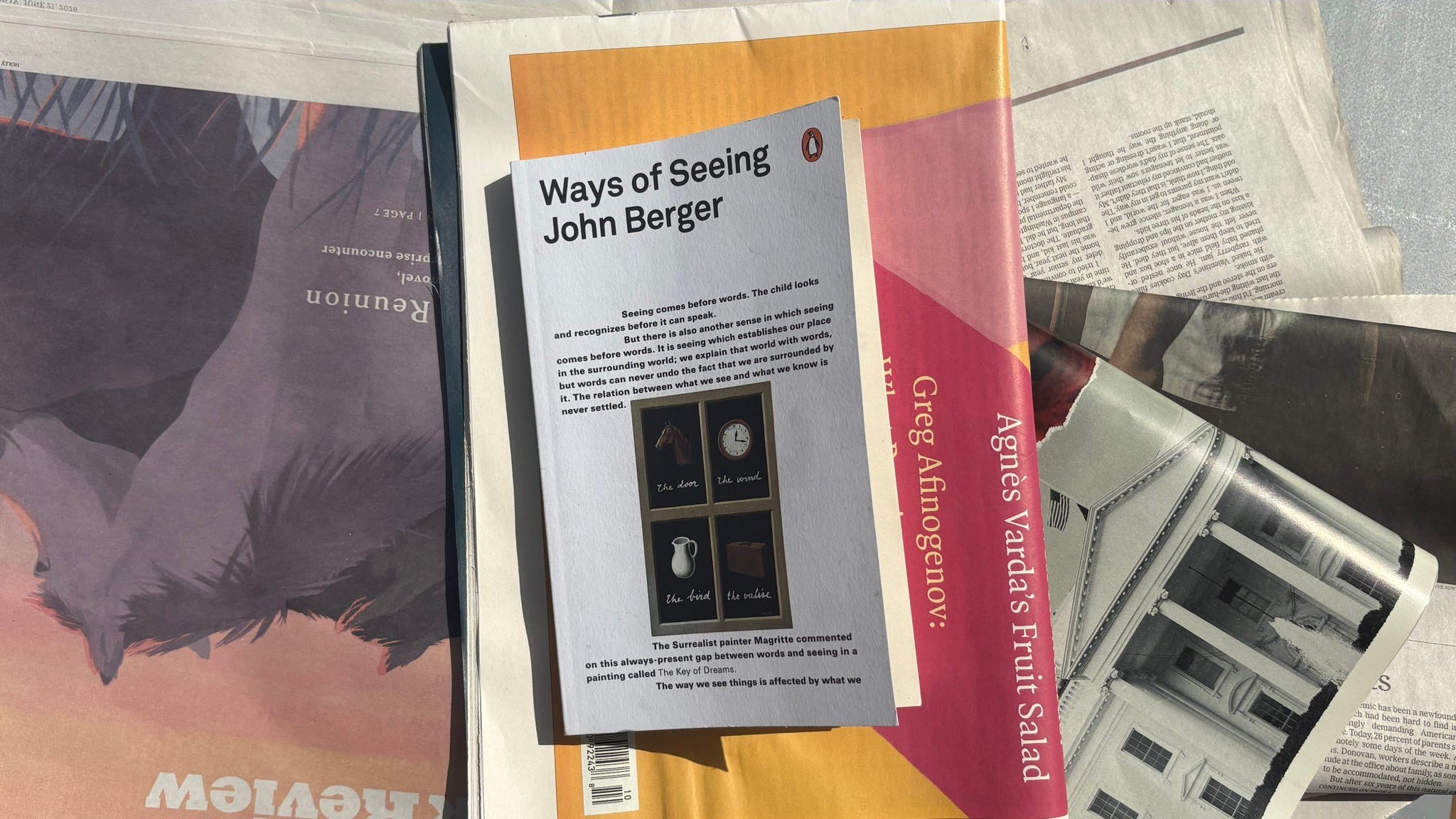
Ways of Seeing’s radical thesis is that it is impossible to understand art, especially painting, as divorced from its particular political, economic, and social context. Attempts to do so, Berger explains, involve mystification, the process by which art is placed on a pedestal, turned into something unimpeachable and unquestionable.
To her grandchildren, my grandmother was not interested in being unimpeachable. She did not want to be subject to mystification. I felt I could ask her anything and she would try to give me an answer. Some wonderful conversations we had started with me asking about whether she had sex in college, how she had evolved on Catholicism, how childbirth was, what she thought about any political thing going on at the moment— I asked her anything that came to mind, however intrusive.
One of Berger’s central insights is that, for our part, seeing is never innocent. We do not simply look at the world; we inherit ways of looking. Every image arrives embedded in social arrangements, cultural assumptions, and structures of power. Berger asks us to challenge not only what we are seeing, but the forces that have taught us how to see it.
Grandma had a restless mind. She would return again and again to the ideas some people sit with all their lives without examining: things like her own family history, the history and politics of our country, art history, and her own personal journey. She was born at the start of the Great Depression into a conservative family in a suburb of Pittsburgh, one of four girls. She ended up a cosmopolitan Chicagoan with a successful marriage, graduate degree, four children of her own, and an unwavering liberal. She did not get there without challenging her ways of looking.
Grandma appreciated Berger’s focus on how art’s creation, evaluation, and preservation reflects the economic environment. Berger argued that the traditional art establishment uses mystification to distance art from its capitalist underpinnings by treating art as the work of the “genius,” untouchable and removed. As you read his essays, a challenge emerges to the apparent meritocracy of great art and the false meritocracy of capitalism itself. I know this appealed to Grandma because similarly, she believed strongly that the ways things have been in this country is no innocent happenstance. She knew that our structures of power have set up their own self-perpetuation and self-mythology insistently and with violence. That profound interest in world history and its inequalities was the backbone of her liberal politics.
My cousin Kate reminded me of Grandma’s reflection on what she learned about this country as a kid versus what she came to learn about it as an adult: “I know now that what we wrote in the history books was wrong.”
Berger’s essays resist closure. They expose contradictions without resolving them. They insist that beauty and power, pleasure and exploitation, art and commerce, can coexist in the same image, but begs us to consider the many sides. Grandma too resisted closure, not in the least because she sometimes had trouble finishing things. But she was a deep thinker, and sometimes procrastination goes with that.
A life cannot be reduced to a single narrative. It exists in multiple versions at once: remembered differently by friends, family, colleagues, and strangers. Like the works Berger discusses, a life exceeds any one interpretation. One must consider the historical context too, and its rapid changes.
I think about Berger’s striking visual essay on the female nude. Berger’s point—that the nude was not a representation of a woman but of a construct of a woman. The male gaze was god: creator and beholder.
My grandmother’s lifetime saw dramatic shifts in both the construct and reality of womanhood. The 19th Amendment was ratified just 8 years before her birth in 1928. At the University of Michigan, she was an associate editor of the Michigan Daily, and won a competitive internship at Mademoiselle in New York after graduating. After the internship, she decided to go back to Chicago and marry her college sweetheart, Frank. She married and had her first child in the 1950s, when the tension between career and motherhood was zero-sum. But as this became less so, she went back to school and earned her graduate degree. She returned to the workforce. The male gaze ceased to be the one way of seeing.
Perhaps one reason my grandmother loved this book is that it treats complexity not as a problem to be solved but as a condition of being human. Berger asks us to live with ambiguity, to question inherited stories, and to recognize that understanding is always partial.
Death fixes a life in time, yet memory keeps altering it. The person is gone, but the meaning of their life is not static. My grandmother was a complicated person with a remarkable intellect. She strived to be good. She had shortcomings, as we all do. She strived to love her children and grandchildren and express that love equally and warmly. As I think about her, old conversations acquire new significance. Certain moments sharpen while others recede. We keep seeing the same life from different angles, discovering things that were always there but not yet visible, as I did when I read Berger’s book.
Berger writes that “every image embodies a way of seeing.” My grandmother leaves behind something less tangible and perhaps more enduring: not a single lesson, but an invitation to resist easy conclusions, to accept that our understanding is never complete, and to challenge our own complacencies. Berger says that “we only see what we look at. To look is an act of choice. As a result of this act, what we see is brought within our reach.” Let us choose to look.
and feel
Death helps us think.