
BOOK BLOG #2
3 nonfiction recs for your perusal + DISTRACTION CORNER

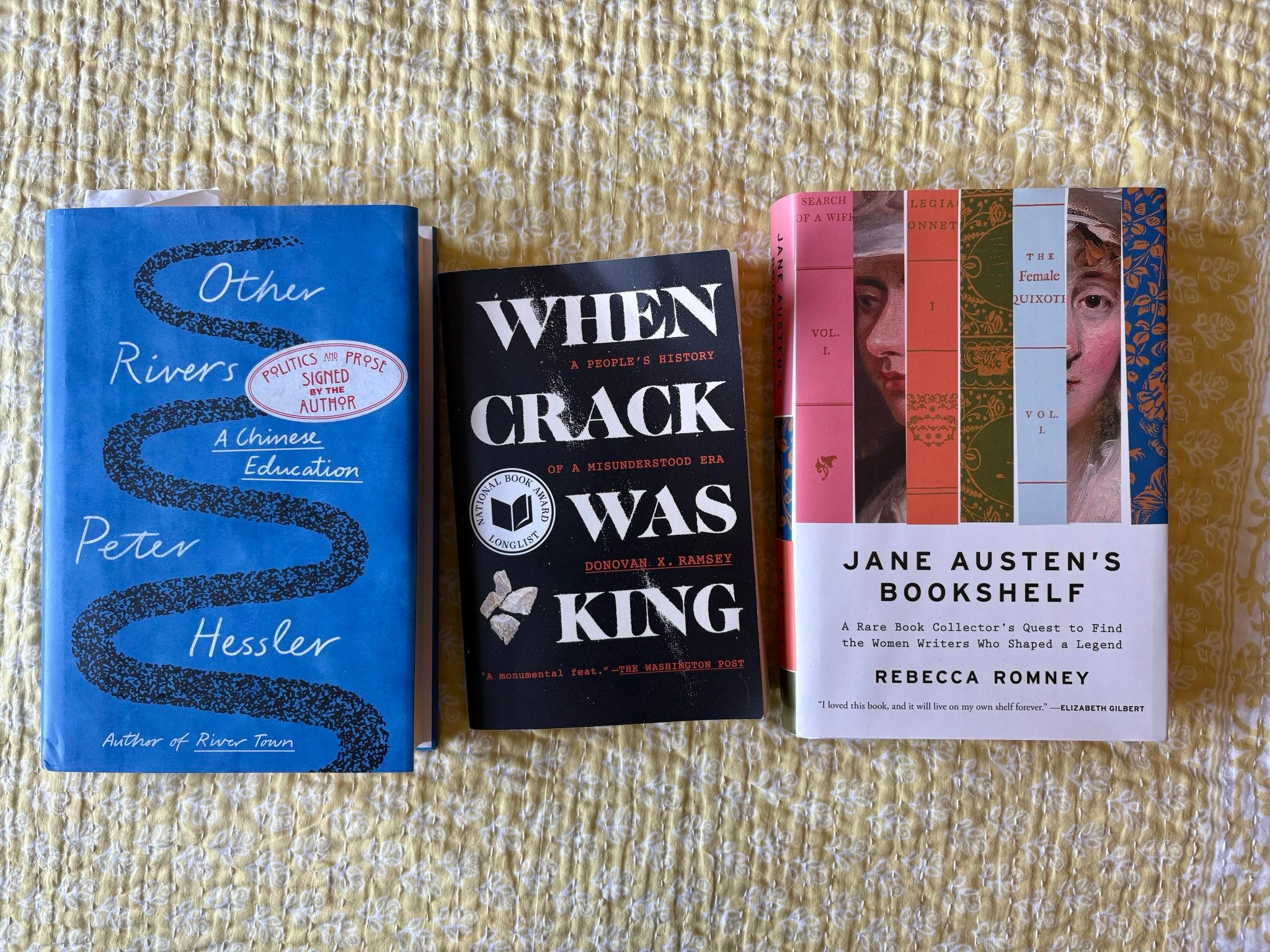
NONFICTION, BABY!
This week I have some NONFICTION recommendations. I’ve been making a concerted effort to read more nonfiction. (I do this once or twice a year; it’s so I can feel morally superior.) Nonfiction is a slog for me compared to fiction…and I suspect I’m not alone in this. These nonfiction books kept my attention.
Jane Austen’s Bookshelf: A Rare Book Collector’s Quest by Rebecca Romney (2025)
Jane Austen was not the only female writer of her time. In fact, many novels in the Georgian era were written by women. Most, including Austen’s early books, were published anonymously as per the convention of the time. However, Austen is subject to a particular optical illusion: that she was the best of generations of female writers before and after her, a female writer without comparison, which is why her work lives on.
Not so, argues Rebecca Romney in this excellent and unusual book of literary criticism. Austen was guided by female authors who came before who were in and of themselves strong writers worthy of attention. But women weren’t given the same latitude by history. Mediocre male writers of the time are memorialized, but Eliza Haywood, Fanny Burney, Ann Radcliffe, and other popular women writers of the time have been neglected in the canon. Not only were they women, but they wrote about women, relationships, and about the home.
Romney is convincing, and the book opened my eyes to the literary study of recovery. It’s one I’ve been interested in in other aspects, for example through the McNally Jackson reprint series, devoted to lost classics. I love learning about books that were popular at a certain time or among a certain population but have totally faded in the collective memory. Gay gems! Books about women! Rona Jaffe’s The Best of Everything! (Which I recommend to anybody who has ever asked their grandmother about her sex life as a young person. It was a best-selling book of 1958.) Of course, it makes total sense that female authors were culled from the study of English literature by the men who dictated what was important and not. I’m glad that people like Romney are standing up for them now.
Romney is a rare book collector and comes to literary criticism with an eye towards acquisition, which is a fun twist. Not only does she discuss the content of the books, but she discusses what it’s like to obtain them. Which is to say, not always easy. (Of course, neither is the reading.) The book offers a fascinating glimpse into the rare book world.
Other Rivers: A Chinese Education by Peter Hessler (2024)
I’m a longtime fan of Peter Hessler, who was for many years the Beijing correspondent for the New Yorker, then the Cairo correspondent. I’ve read all his books. His first chronicled his time in the Peace Corps stationed in China as a teacher. His style of nonfiction has historically been extremely controlled. He exists as an eyeball, and barely as a character. Memorable New Yorker essays about, for example, him participating in a matchmaking service in China and delving into the matchmaking industry there, assiduously avoid discussion of his personal life. He’s the interviewer who has cut out the entirety of his own voice asking questions and talking about himself.
Other Rivers is less tight in that way. This time, he is writing about his own life, and his children (and their experience in the Chinese education system) feature heavily. He discusses the changes in the region since he himself taught in China. Now at Sichuan University, he teaches the next generation than those he taught in Fuling-- a different generation with different concerns. China has experienced exponential transformation, moving from a rural, agricultural economy into an urban one during his time away.
American exceptionalism means believing that life here is vastly better than life in, for one, China. Decades of anti-Chinese propaganda and extreme speech about China that Americans have been subjected to have been successful in creating an unnuanced, negative view of Chinese society. And yet, Hessler has always succeeded at chipping away at the false simplicity of American exceptionalism. The Chinese view on education feels a world away from the cruel decimation of the university system happening currently here in the States. The Chinese students Hessler writes about hold deep reverence for education. The young people he first taught were in their way a testament to that. As China’s economy changed from agricultural, uneducated farmers made huge sacrifices so that their children could be the first to go to college.
Which is not to say that Hessler is some starry-eyed propagandist himself. Running parallel to the story of Hessler’s teaching year is his twins’ school year; they attend a high-powered elementary school. The school’s emphasis is on memorization rather than creativity or critical thinking, and children are piled with unending amounts of schoolwork. For Hessler, the country’s censorship issues end up being his undoing, and the culture of reporting on others ends up feeding an online rumor mill about his teaching. At the end of the book, he ends up leaving China because he is worried he’ll be detained and his family unable to return to the United States.
The book is also an on-the-ground accounting of how China dealt with Covid: how the government covered up information and then infringed on people’s freedom of movement in order to successfully control outbreaks.
When Crack Was King: A People’s History of a Misunderstood Era by Donovan X. Ramsey (2023)
Journalist Donovan Ramsey details with empathy the rise of crack cocaine, and the huge misunderstanding that persists even now about the different forms of cocaine. (Whitney Houston is a good example of this. She was put on live television a bunch of times during her career and asked about her drug use. She denied using crack to Diane Sawyer in an incredibly icky 2002 interview, saying that “crack is cheap. I make too much money for me to ever smoke crack.” Years later, she revealed that her favorite drug was pot mixed with freebase cocaine, aka a smokeable cocaine.)
Crack became popular because it offered a much greater high (because it’s smoked, and enters the brain incredibly fast) at a cheaper price point. But for that reason, it created desperate addiction: people on the drug can develop the need to re-up many times a day. The high lasts only 5-20 minutes.
Ramsey makes a compelling argument that crack was an answer to a rising desperation felt by groups of people that government policies were squeezing into economic isolation. And of course, the rise of crack coincided with a huge increase in incarceration, aided by the punitive anti-drug legislation of the 80s. Ramsey gives the subject matter and the former addicts and dealers he interviews care. His pacing of interviews with the same subjects interspersed chronologically helps to avoid a heaping up of trauma voyeurism even as he delves deeply into people’s pain.
On DC, of personal interest to me:
The book profiles in short a period from 1989-1990 where George H.W. Bush’s drug czar, William Bennett, essentially declared war on DC, declaring that the crime ridden city would be a test case for the rest of the country. (Bennett had no experience with drug policy or law enforcement.) In H.W.’s first address to the nation in 1989, he addressed the drug epidemic and held up a bag of crack cocaine theoretically seized from the drug dealers who were flooding even the area by the White House with cocaine. (In actuality the drugs were obtained with much difficulty on order of a president who wanted to use the cocaine as a prop.) DC even then was a punching bag for conservatives, and the choice testing ground for Bush’s renewal of the war on drugs, despite the fact that drug use was waning nationally.
On “crack babies”:
The fallacy of the crack baby was perpetuated far and wide, including by Nancy Reagan, and used to further stigmatize an already stigmatized group of people: drug users, poor mothers, and their families. The idea was popularized by anecdotal and sensationalist reporting about crack.
In the period of the time before the crack epidemic, the country was engaged in a heated debate over government assistance. Reagan brought the term “welfare queen” into popular parlance during his 1976 campaign; and during his eight years in office he reduced welfare spending and tightened eligibility requirements. In short, the idea of a baby born addicted to crack cocaine, a sign of a generation that would supposedly grow up to drain government resources and the medical system, was positioned to be uniquely threatening.
Ramsey details how the myth of the “crack baby” was an unscientific and cruel lie, used to help justify draconian drug legislation. A landmark study was unable to prove directly that children exposed to cocaine in the womb were born damaged. While drug use does increase the likelihood of premature birth, these babies were certainly not the hopeless cases that the media indicated they would be. The development of these babies was proved in this longterm study to be normal, actually. (Fetal alcohol syndrome causes more damage than cocaine use.) Poverty has more of an effect on child development than a mother’s cocaine use.
DISTRACTION CORNER
On 50 years of Fresh Air: Terry Gross was interviewed at length by Sam Fragoso about her career, the death of her longtime husband, and difficult interviews she’s had. The resulting conversation is really moving; I especially liked the Maurice Sendak interview clip.
On moving our bodies: I loved this funny NYT Book Review piece from August about exercise inspiration found in books.
On Jane Austen: Recommend this old episode of historian Kate Lister’s podcast Betwixt the Sheets on what Jane Austen knew about sex that I came across this week.
On Patricia Lockwood: I enjoyed this New Yorker profile of Lockwood, the author of the amazing memoir Priestdaddy. I’m such a fan of Lockwood, who has a new book out of autofiction next week that I’m eager to read.