
BOOK BLOG #19
Some light reading about the brutality of British football hooliganism

I had been eyeing this book since Christmas, when a family member received it as a gift and I was deeply covetous. Finally, I got it from the library and over the course of a couple days, devoured it. I read it late into the night, hours after everybody in the house was asleep. And then after reading it, I was so disturbed by thoughts of death and the existential nothingness at the heart of crowd violence that I stayed up all night.
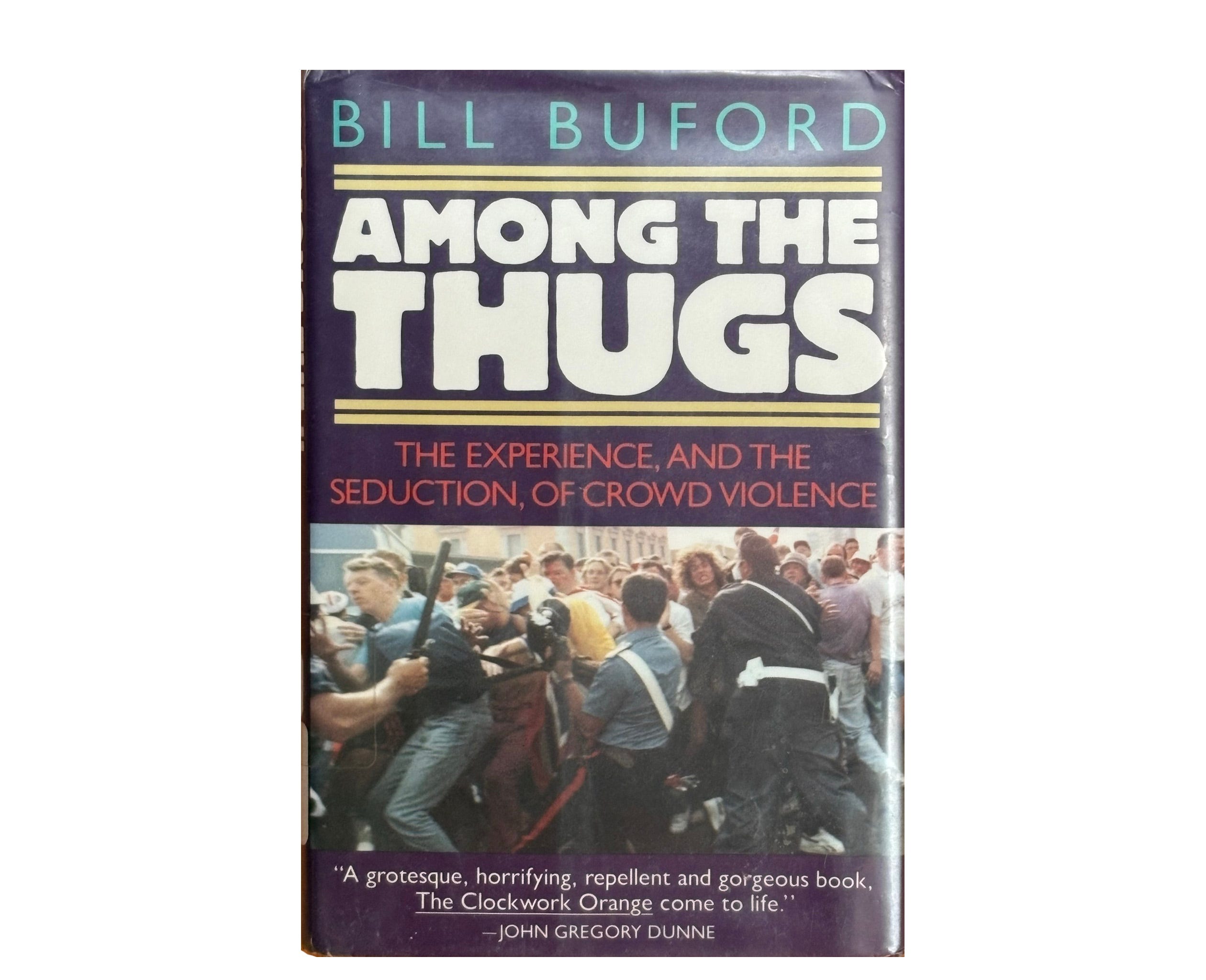
Among the Thugs by Bill Buford (1990)
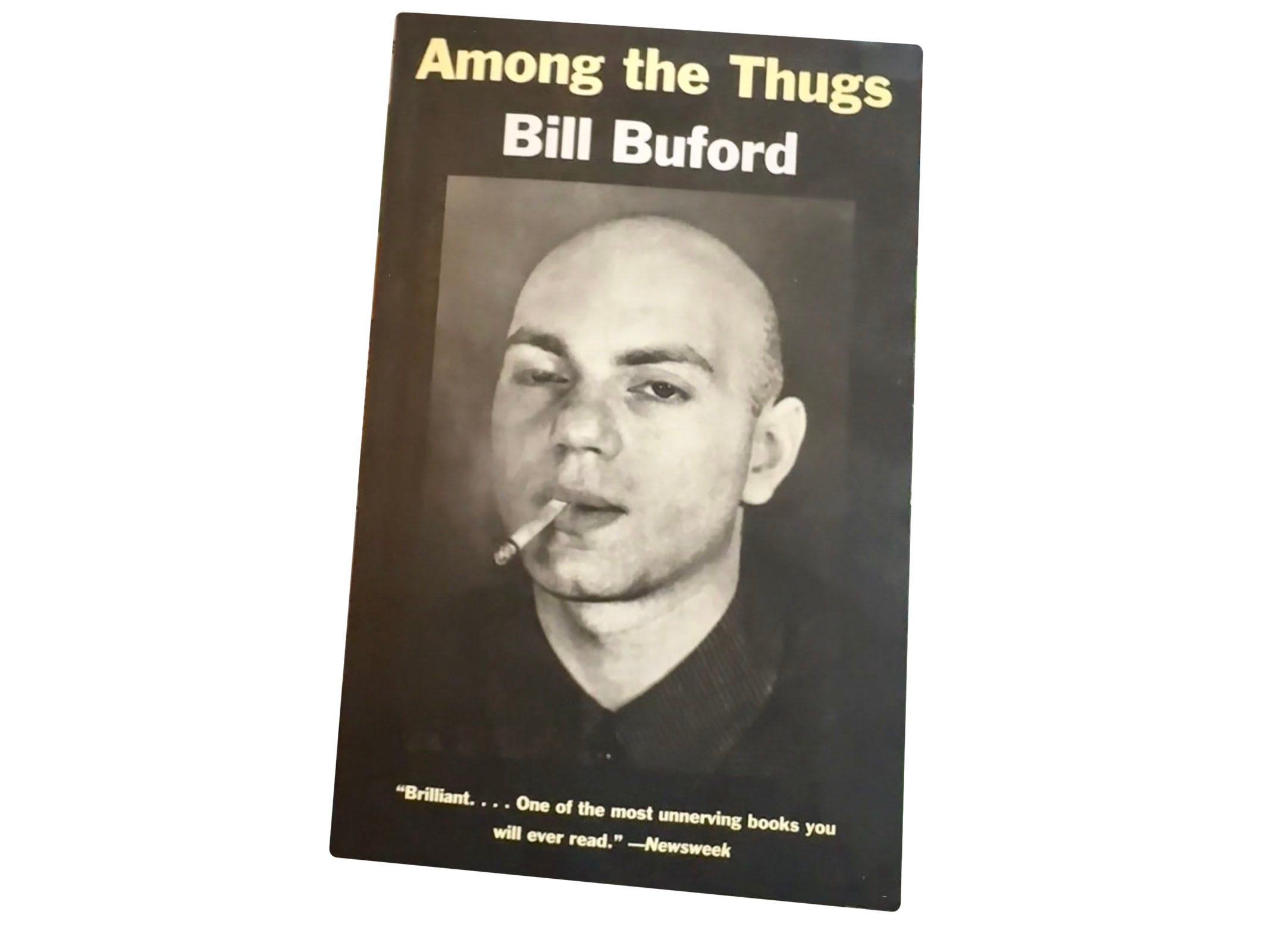
Among the Thugs is an account of British football hooliganism in the 1980s. This kind of sports-based rioting is pretty much anathema to Americans; even the word “hooligan” does not have the same associations here. The United Kingdom is small enough that traveling to games is realistic and there is an incredibly strong drinking culture associated with football. In America, games are viewed mostly on television; fans don’t travel to each game. The fans who get drunk while tailgating or at the bar largely don’t end up committing violence. Disgruntled American football fans will sometimes wander a city in their oversize jerseys after a game in search of a bar, but with the exception of sometimes Eagles fans they are not rioting. In England, it is very different. Spectator violence has always been a part of football culture, and this behavior has deep roots.
Buford, a journalist who went on to become the fiction editor of the New Yorker, is graphic in his detailing of both the violence and its participants.
I found myself neither in conversation nor not in conversation but looking into a particularly ugly mouth. I can’t recall how I arrived before this mouth—zigzagging across the square—but once in its presence I couldn’t take my eyes off it.
In it, there were many gaps, the raw rim of the gums showing where once there must have been teeth. Of the teeth still intact, many were chipped or split; none was straight: they appeared to have grown up at odd, unconventional angles or (more likely) been redirected by a powerful physical influence at some point in their career. All of them were highly colored—deep brown or caked with yellow or, like a pea soup, mushy green and vegetable soft with decay. This was a mouth that had suffered many slings and arrows along with the occasional thrashing and several hundredweight of tobacco and Cadbury’s milk chocolate. This was a mouth through which a great deal of life had passed at, it would appear, an uncompromising speed.
This passage for me was an excellent metaphor for Buford’s investigation into why seemingly “normal” sports fans commit incredibly dark acts of violence against opposing fans and also just random, especially nonwhite, people. A thread throughout the book is Buford’s bafflement at finding that investigating the very center of this violence, where the heart of the matter should lie, in fact, there is only a cipher, a nothingness— a disgusting, empty mouth.
Why this kind of antisocial conduct? I couldn’t separate the end—this exhilaration—from the means that got people to it; I couldn’t treat it as this generation’s thing, its rock and roll. There are endless precedents for extreme forms of behavior—especially violence—but not for organized violence, not for violence pitched at achieving this kind of frenzied high: the crowd high. this was unusual. And, amid all the different factors that contribute to why an assembly of people becomes a crowd and then, ultimately, a violent one, there is almost invariably a political or economic cause of some kind, even if the cause is cosmetic or rhetorical—a grievance or an injustice or at least a hardened feeling of social frustration—and I couldn’t get away from the starkness of the conclusion I kept reaching: that there was no cause for the violence; no “reason” for it at all. If anything, there were “unreasons”: rather than economic hardship or political frustration, there was economic plenty and an untroubled, even complacent faith in a free market and nationalistic politics that was proud of both its comforts and its selfishness.
I couldn’t believe that what I saw was all there was.
Buford is incredulous that men who hold down jobs, who have small businesses and own houses, have families, wives, and children, can commit atrocious acts of violence and torture. But inherently— this is not contradictory, however much we would like it to be to ease the cognitive dissonance.
Buford delves into hooliganism’s relationship with nationalist and far right groups in Britain, and reveals how pro-Nazi groups try to recruit membership from football fans. The relationship between the far right and hooliganism is a shared sense of not actual but perceived disenfranchisement. The nationalism too is a shared value, on display for football fans for example when England teams play other countries. And then there is of course a common interest in violence, often against marginalized groups; and yet, hooliganism taps into something chthonic that is more than just organized crowd violence—a trance-state which reason cannot explain.
If you are different in an acceptable way, i.e. a white man from America like Buford, you are given a privileged seat as an outsider and explained things, as Buford is. He profiles a variety of fans inside the football “firms”— “firms” being gangs of hardcore fans who organize premeditated rioting, violence, and intimidation of the other team’s fans. (These “firms” also handle logistics of getting large groups to the games, quite difficult if you are banned from doing so, and occasionally engage in unrelated criminal activities.) Clearly Buford was very good at getting his subjects to trust him, which he admits causes him some consternation. Several of his accountings of the crowd violence veer into uncomfortable territory, because one wonders if to be present is to partake. At one point, mistaken for a group leader in a riot, Buford is beaten badly by police, who attack him with the same zealousness that he has seen football hooligans beating someone who got in their way.
As an outsider, Buford is well-positioned to ask why it is that football hooliganism has historically been so violent, and if it is simply an outlet for white fans who feel a deep sense of economic, cultural, or racial disenfranchisement. What he finds is much more macabre— that those are excuses but not the reasons.
The Keith Richards look-alike was disconcertingly self-aware. He knew what a journalist was hoping to find in him and that he provided it. He worked in a factory, making soap powder. “The perfect profile of a hooligan, isn’t it?” he said. “He works all week at a boring job and can’t wait to get out on a Saturday afternoon.”
I nodded and grinned rather stupidly. He was right: the disenfranchised and all that.
He sneered. It was a wonderful sneer—arrogant, composed, full of venom. “So what do you think makes us tick?” he asked. “If we,” he said, not waiting for my answer, “did not do it here at football matches then we’d simply end up doing it somewhere else. We’d end up doing it on Saturday night at the pub. It’s what’s in us, innit?” He had an intense, but rather practiced, look of contempt.
What’s that? I asked. What is it that’s in us?
“The violence,” he said. “We’ve all got it in us. It just needs a cause. It needs an acceptable way of coming out. And it doesn’t matter what it is. But something. It’s almost an excuse. But it’s got to come out. Everyone’s got it in them.”
I remember being on a crowded train up to Sheffield a couple years ago on an afternoon and being surrounded by men in groups, each one carting his own 6-pack of beer. There was a Sheffield United game that night, and the train was absolutely packed. (Sheffield, it should be noted, was the site of the Hillsborough disaster in 1989: a fatal crowd crush at a match in which 97 people died.) My takeaways at the time were in retrospect quite naive. I thought it was nice to see these groups of male friends traveling to the match together. I thought it was quaint that drinking freely on trains is allowed in England.
I had to stand. I was across from an Indian grandmother in a sari, her daughter, and her daughter’s two young kids. All three generations were also standing while the football fans had crowded into all the seats with their bags of booze. The grandmother did not take her eyes off the men sitting and drinking the entire train ride. At the time I thought it was a bit strange how fixated she seemed on them, but now I wonder if she was simply privy to an understanding of what these men were capable of that I was ignorant of then. After all, hooliganism is frequently racialized: whether it be the appalling abuse of Black players by fans or violence against nonwhite fans or nonwhite bystanders.
When we disembarked at Sheffield, the train car was awash with empty bottles. Not a single beer had been left undrunk, and each man, most of whom had drunk approximately 6 beers on the two-and-a-half train journey from London and some of whom had been drinking surreptitiously straight from handles of liquor, then proceeded to the pub before they went to the stadium that night.
I was talking recently with a friend who lives in London and is a huge Arsenal supporter (and author of books about French poets) and asked about the hooligans at matches. It doesn’t exist really any more, he said: the teams have priced the tickets high and those guys can’t afford to go to games anymore.
We're in the UK now and staying about 2 miles from the Arsenal stadium. The Gunners just won the Premier League for the first time in 22 years so all we're seeing are fans kitted up in red & white with giant shit-eating grins roaming around! Have always wanted to read Thugs though (as well as the Nick Hornby football book), so thanks for the reminder!