
BOOK BLOG #16
In which I share 3 of my favorite books about BOARDING SCHOOL

Boarding school, a hermetically sealed space where the minds of young people are a battleground, is such a rich fictional setting. The stakes are high. I love all three of these— different as they are.
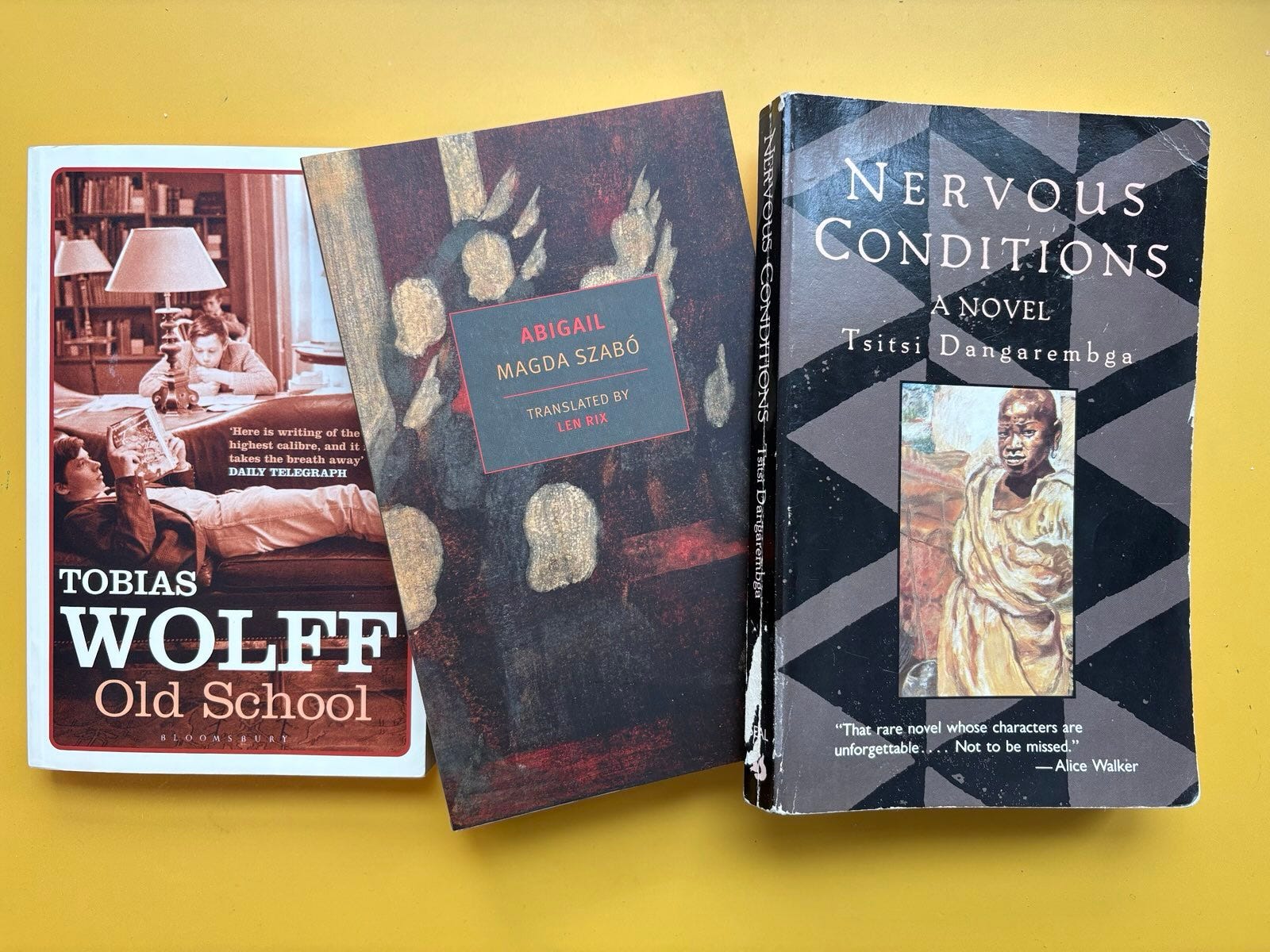
Nervous Conditions by Tsitsi Dangarembga (1988)
Nervous Conditions is a brilliant novel set in the period of white rule in then-Rhodesia, now-Zimbabwe, in the late 1960s. The book follows a young girl from a poor family who takes her brother’s place at a mission school in the wake of his unexpected death. In 1965, the white minority settler population declared independence from Britain (which had colonized Rhodesia around 1900, led by the supervillain Cecil Rhodes). A long civil war ensued, ending in 1980 when the settler regime was forced to give up power to the Black majority. Zimbabwe was one of the last African colonies to get self-governance. (If you’re interested in other Zimbabwean writers, I recommend NoViolet Bulawayo, who wrote a satire about the end of Mugabe’s 37-year “term” in office; her earlier We Need New Names scalded me.)
Our heroine, Tambudzai, begins attending her brother’s mission school and goes to live with her successful uncle and her cousins, Nyasha and Chido. In her new mission school, Tambu is immediately placed under high pressure but rises to the occasion, flourishing academically. At the end of the term, she has performed so well she is offered a place at a boarding school run by nuns; there are only a few African students there, who are treated differently than the white students. By the end of the book, when Nyasha develops a serious eating disorder and Chido becomes involved with a missionary’s daughter, Tambu’s mother says bitingly, “It’s the Englishness. It’ll kill them all if they aren’t careful.” It’s true for her daughter too, but Tambu is only just starting to understand the crushing effect of that Englishness as she sacrifices more and more to further a colonial education.
Dangarembga places an epigraph before the first chapter that lends the book its title:
“The condition of native is a nervous condition.”
From an introduction to Fanon’s The Wretched of the Earth.
I was interested in the context of this quote and looked it up. The introduction in question is by the philosopher Jean-Paul Sartre, and the book’s version of the quotation is both truncated and amended (removing the quotation marks around “native”):
“Our enemy betrays his brothers and becomes our accomplice; his brothers do the same thing. The status of ‘native’ is a nervous condition introduced and maintained by the settler among colonized people with their consent.”
I was struck by this apparent discrepancy, which I don’t see that Dangarembga has addressed. I kept getting tripped up on the phrase “with their consent,” which seems to lay some measure of blame at the feet of the “native.” And yet, Sartre and Fanon (The Wretched of the Earth was a seminal book on the psychological effects of colonization) were fervent anti-colonialists. For Fanon and for Sartre, violence was an unfortunate but necessary tool for liberation— decolonization is inherently a violent process because only violence can break through the oppression of colonization. For Sartre, the placement of “native” in quotations seems to draw it into question, as if using the word involves caving to a classification that eases the colonizer’s view. I’m not sure whether Dangarembga’s removal of the scare quotes and “consent” language represents the kind of giving in Sartre seemed to be getting at, a rejection of his view, or simply a writer’s search for pithiness.
University of Michigan Professor David William Cohen has a great article about Nervous Conditions that also discusses the epigraph, and he suggests that Dangarembga’s erasure of the quotation marks further reflect her interest in the complexities of the supposed “native,” rather than the idea of Zimbabweans as a monolith defined by their race.
Abigail by Magda Szabó, translated by Len Rix (1970)
Magda Szabó’s book about Hungary in 1943-44 is beloved in her home country for good reason. The book follows Gina Vitay, an intelligent but rather coddled 14-year-old whose father has decided, in her eyes totally unexpectedly, to send her off to a strict boarding school. There she becomes fixated on a statue named Abigail that is rumored to have supernatural powers.
After entering the World War II in 1941 as an Axis ally, Hungary essentially tried to flip sides. Gina’s father, General Vitay, a high-ranking Hungarian officer, is secretly involved in the Hungarian Resistance. To protect his daughter and keep his activities hidden, he sends her away to the strict Calvinist boarding school in Debrecen and cuts off their previously affectionate relationship. This is strategic on his part, as he tries to both protect her from the war and distance her from his activities. The book is from her perspective, though, and his decision is baffling and heartbreaking to her. Over the course of the book, as Gina matures and begins to understand more and more about the situation, so does the reader.
Old School by Tobias Wolff (2003)
Old School is a classic, semi-autobiographical (cf. with Wolff’s memoir This Boy’s Life) story of an unnamed Jewish scholarship boy at an elite New England boarding school. The main character, after essentially being abandoned by his family, throws himself into the pursuit of literary stardom—a measure of success the boarding school boys regard above all else. The school hosts a number of distinguished writers, and the students can receive a private audience with a famous writer by composing a winning poem or story. After failing to win an audience with either Robert Frost or Ayn Rand, our narrator is determined to be chosen by Ernest Hemingway.
The main character is ambitious and insecure, and sees writing as his lifeline to a more elevated life. He believes that understanding literature and poetry will lead to an understanding of the soul, and also, more importantly, to glorious reward. But through his fixation on winning an audience with a famous writer, he comes to find that there’s a difference between the performance of literary talent and developing a genuine voice. And to do the latter, he might have to come to terms with his otherness— as a Jew in WASP territory, a scholarship boy in a sea of privilege and without a supportive family.
“By now I’d been absorbed so far into my performance that nothing else came naturally. But I never quite forgot that I was performing. In the first couple of years there’d been some spirit of play in creating the part, refining it, watching it pass. There’d been pleasure in implying a personal history through purely dramatic effects of manner and speech without ever committing an expository lie, and pleasure in doubleness itself: there was more to me than people knew!”
MORE MORE MORE
Other Excellent Books Set in Boarding Schools
A Separate Peace by John Knowles (1959)
The classic boarding school novel: one boy revisits his New Hampshire boarding school days after fifteen years. Tragic memories ensue.
Mrs. S by K. Patrick (2023)
A butch Australian woman gets a job at an all-girls English boarding school and has a passionate affair with the headmaster’s wife.
Skippy Dies by Paul Murray (2010)
Skippy, a student at a Catholic boarding school in Dublin, dies suddenly in a donut shop. But how?
Prep by Curtis Sittenfeld (2005)
A scholarship student from Indiana navigates four years of hell at an elite Massachusetts boarding school.
If you have any others you would recommend, let me know!
Distraction Corner
In awe of: Ilhan Omar’s courage while being assaulted by a man attending her event.
Taking note: A University of Alaska Fairbanks student protested an AI art exhibit of polaroids by eating them. I think he made his point quite eloquently.
Reading: Journalist Laura Jedeed wrote about how easy it is to get hired by ICE. (You can also listen to Jedeed tell the story in various places including on What a Day.) She herself, despite being a journalist and a vocal critic of ICE who had just smoked pot and thus wouldn’t pass the drug test, was offered the job despite not really trying at all. This all to confirm what we already know— it’s not the best and the brightest out here. Moreover, she seemed to be given a start date before even passing a background clearance.
Recollecting: In late January 2025, I took these pictures at USAID, where I was working at the time. (Empty photo frames in the hallways, TVs tuned to Fox News, where a version of RFK Jr.’s confirmation hearing was playing.) Trump had just been inaugurated, but we didn’t know that USAID would be his first target. Shortly thereafter, I and many of my coworkers would be laid off and USAID would cease functioning.


Two of these have been recommended to me, but I might be most intrigued by the one that hasn't been! 👀 (Abigail...)
One of my favorite books of recent years is Rebecca Makkai's "I Have Some Questions For You" which is set at a boarding school (pretty sure Makkai's husband works at a boarding school so I'm sure she's had great material to work with).