
BOOK BLOG #15
In which I write about two totally disparate but amazing books about young women

Sound the alarms, I finally read Mary McCarthy’s The Group— her deeply pessimistic 1963 novel about eight Vassar graduates in the 1930s— and I highly recommend it.
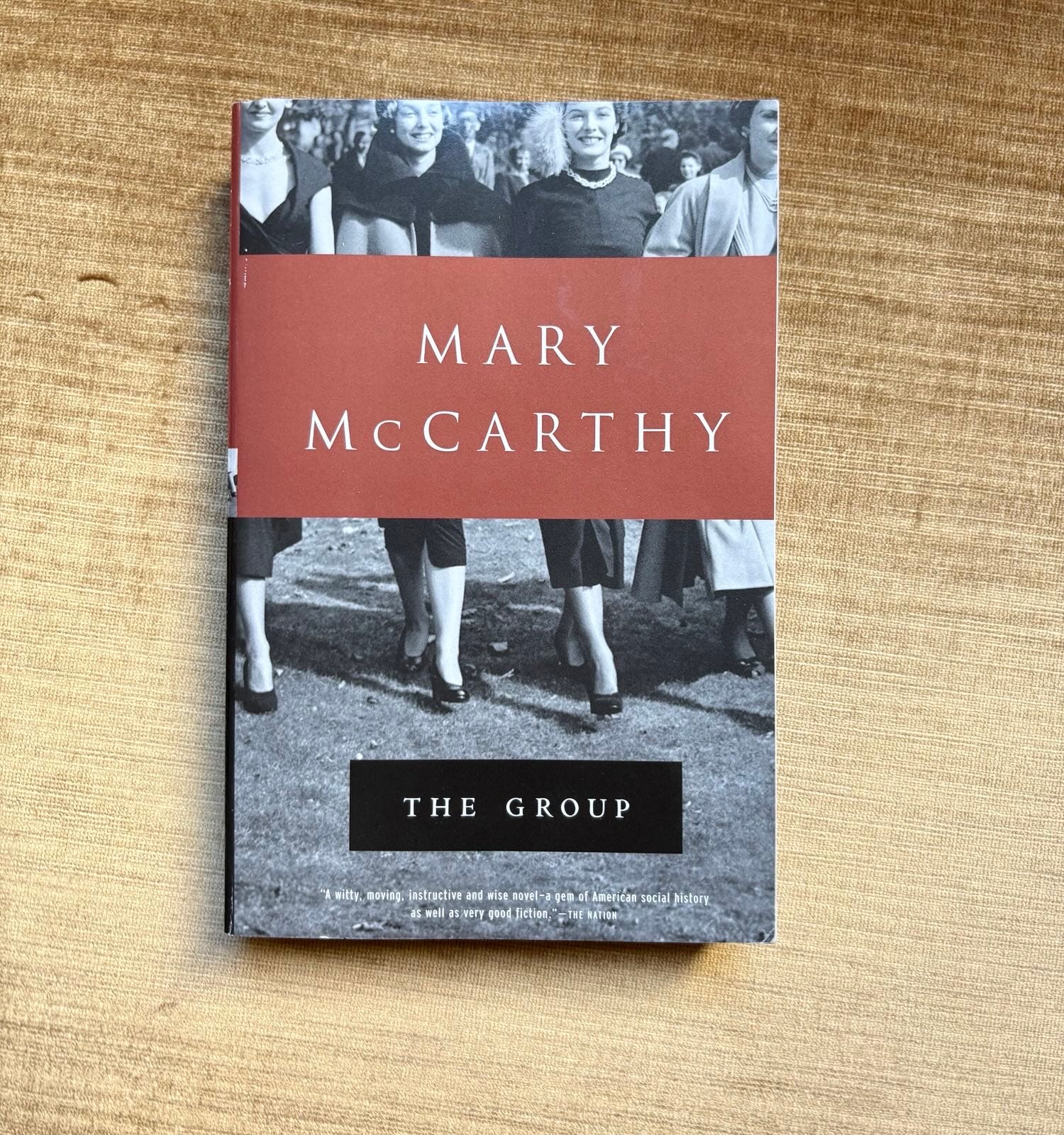
The Group by Mary McCarthy
The Group follows eight Vassar women of the class of 1933 going out into the world with one goal in common: not to become their parents. They are college graduates coming of age in a country shaken by the financial crash of 1929.
In the 1930s, more and more women were getting an education. And yet they were still overwhelmingly expected to return to a traditional family role afterwards. Women got a taste of self-determination, and as in The Group, they didn’t necessarily want to return to the mores of the past. The entry of an educated but middle-class generation of women into society complicated class structures too.
These tensions are among those The Group explores. The book begins with the wedding of Kay and Harald several weeks after graduation, and ends with Kay’s funeral a couple years later in the very same church. In between, Kay is involuntarily committed to a mental institution by her abusive, philandering husband. (Her storyline also reminded me of Richard Yates’ Revolutionary Road, published two years earlier but about a suburban couple in the 1950s.) Like Yates, McCarthy presents all these problems, and no real answers, leaving us buffeted between these women’s engaging minds as they take on their lives and a deep, unsettling pessimism about their futures.
For us here in 2026, McCarthy is an anthropologist too. The logistics (bulky) and concerns (myriad) of being a woman in the 1930s are revealed to us through the characters navigating birth control…the impossibility of casual sex…being a modern woman…the impossibility of being a modern woman…and on and on. The one option McCarthy seems to really endorse is being a lesbian and leaving for Europe. Take that as you will.
With the new year comes a renewal in my love of reading, a great surge of optimism about my capacity, and a renewed desire to read more books in translation.
Tali Girls by Siamak Herawi
I had almost finished writing about The Group, which I finished right after the new year, when I came across the book Tali Girls by Siamak Herawi. The two books have nothing in common, but they both ignited something in me.
Translated masterfully by Sara Khalili, Tali Girls is a tale of rural Afghanistan that begins in the early 2000s. Written in 2018 in Persian, it was published in 2023 by Archipelago.
“This is the twenty-first century!” he shouts out to the crowd. “The year 2006! Villages and towns in this province still have no electricity, no plumbing for water, no paved roads. We have no doctors, no medicine! At least let our children go to school and grow up literate and educated.”
“No!” Mullah Sikhdad cries flushed with anger. “Our children will be corrupted. They will grow up faithless sinners!”
This exchange exemplifies the book’s central conflict between the villagers’ desire for education and the conservative religious leaders’ desire for power. Just as in the U.S., morality is an excuse to control women.
Even the parents of the book’s main character Kowsar, who are supportive of their daughter and eventually receptive to her receiving an education, casually call her a wretch. This is what they call all the girls. Her mother says matter-of-factly: “A wretch has no voice of her own. No one will ask for her consent. She marries when the man of the house says so. And then she breeds and cooks and cleans. It is life, my dear.” But we see that Kowsar, a keenly intelligent student who is encouraged by her teacher and a village elder, changes her mother’s view— simply by proximity of her education.
In 2001, the U.S. entered the country and ostensibly overthrew the Taliban, establishing a new Afghan government under “Operation Enduring Freedom” (originally “Operation Infinite Justice”)—a name that signaled that the Bush Administration, however misguided, understood that the fight against terrorism was a long term investment. The book’s action starts a year later when the Taliban are starting to encroach on small villages like Tali.
I was working for the Democratic party apparatus in 2020 when the Trump Administration was agitating to withdraw all its troops from Afghanistan after almost 20 years in the country. This certainly appealed to a public frustrated with our long, unsuccessful engagement in the country and our inability to actually get rid of the Taliban— also a public concerned with the budget and interested in the America First agenda. I remember vividly working on a project tracking how the first Trump Administration, and Mike Pompeo’s State Department more specifically, abandoned the notion of advocating for women of Afghanistan during the process of the so-called Doha Accords. Again and again, Pompeo claimed facetiously that any talk of women’s rights was an intra-Afghan issue.
Pompeo’s insistent glibness and total abdication of responsibility stands out in my memory: “I hope the women of Afghanistan will demand [equality] of their leaders,” he said when asked about how the peace deal wasn’t contingent on any action on women’s rights. He added smugly, “We’ve always done our part there.”
It doesn’t matter. Any lip service to women’s rights in this deal was besides the point as this negotiation was entirely fake. It was real in that it existed; it was fake in that nothing could have stopped the Trump Administration from withdrawing from Afghanistan. The final deal was not contingent on any promises made about women’s rights. But again, that doesn’t even matter because there can be no negotiations with a group like the Taliban, which has a long, long history of reneging on its promises. After 9/11, the reason Bush invaded Afghanistan was that the Taliban could not be trusted to turn over Al-Qaeda terrorists.1 The Taliban’s cruelty, especially towards women, was also always used as justification for American presence in the country. But the Trump Administration had no problem with these contradictions when setting up negotiations with the Taliban, because it wanted the easy glory of a fake peace deal. Not our problem anymore! The Trump Administration’s logic here defies Republic orthodoxy in rendering the deaths of thousands of servicemembers in the line of duty in this conflict seemingly pointless.
In 2021, the U.S. withdrew from Afghanistan completely under the terms of the Trump Administration’s deal. The Taliban took over the government, and has since barred women from secondary education, entering the workforce, and being in public spaces. The Taliban has nevertheless been taking part in U.N. and other international meetings in Qatar in the last couple years. In 2025, the group dismissed women’s rights as an internal issue that would be dealt with based on Sharia law. Although the Taliban is not recognized as a legitimate government by any country except Russia, recently, the group is somehow allowed to participate. This is the legitimacy that the Trump Administration’s deal gave them.
I could go on, but I won’t. The Taliban’s arbitrary and vicious violence against women and anybody who dares to stand against them is well-documented. This book is its own record of Taliban conduct and there were several times where I had to put it aside. One such point was when a nine-year-old girl is married to evil Mawlawi Khodadad, an education official and an ally of the Taliban, who brutally dismembers her. Khodadad goes on to kill other women, all with the power of his status as a religious leader and the support of the Taliban behind him. (A former schoolmate reveals that Khodadad had no aptitude for religion, was a thief and criminal, and came to his role corruptly.)
The women of the book are heroic, and even the ones with no education understand that the Taliban are poison to Afghanistan’s progress. Women are relegated to currency, property, and free labor. As Kowsar says as she tries to help a friend who runs off after being promised to a Taliban leader:
That’s how it is in this country. They stopped burying women alive when they realized they can buy and sell us as brides, claim us as blood money, take us as slaves, offer us as gifts. They reckoned, why bury all this wealth?
Tali’s positioning in a valley shows the difficulty of Afghanistan’s rugged landscape: its terrain is extremely mountainous, difficult to navigate, and villages are often very isolated. These are areas where the Taliban easily take control. In this case of Tali, the Taliban close the school and set up poppy fields instead, which have the double benefit of providing funding for the group and snaring the infidel in drug use.
And yet it is clear from this book what is clear from the dwindling news reports about Afghanistan: the girls and women there have a fierce desire to have the right to educate themselves. As we hold the young people of Iran in our minds, I think too of the Afghan women and men that we have abandoned.
Perhaps because where I live has been bitterly cold, but W.H. Auden’s “In Memory of W.B. Yeats” has been on my mind— a beautiful poem commemorating the death of Yeats in winter:
Now Ireland has her madness and her weather still,
For poetry makes nothing happen: it survives
In the valley of its making where executives
Would never want to tamper, flows on south
From ranches of isolation and the busy griefs,
Raw towns that we believe and die in; it survives,
A way of happening, a mouth.
The quote “poetry makes nothing happen” has been used a million times and out of context; I have forcibly separated these lines from the rest of the stanza— but I think much more of those last lines: “it survives,/ A way of happening, a mouth.” Art survives! It is a mouth. I hope to see more of Herawi’s works translated into English.
DISTRACTION CORNER
Watching: Department Q on Netflix, an excellent dark detective show set in Edinburgh.
Listening: Somi, a jazz singer whose mellow stylings are giving me strength.
Thinking: One of my goals for this year was to disregard the false sense of urgency to consume new material, whether that be buzzy debut novels, bingeing all the award nominees of whatever medium, watching the new reality show, whatever. I’m trying to ward off the false urgency of consumption and consume what I want when I am moved to. I’m not particularly timely (as you can see from my recommendations of books from 1963 and 2023) but I’m right on time.
Not to mention that the U.S. had a role in the 1980s in propping up the Mujahideens, the Islamic fighters, against the Russians…the Mujahideens created the conditions for extremist groups like the Taliban to flourish…some of them simply became Taliban members…contributing to the rise of Islamic extremism in the country that the U.S. then invaded to address twenty years down the line…
Another great round-up. I've been fascinated by Afghanistan (and US involvement there) since I read Steve Coll's brilliant "Ghost Wars" about CIA involvement in the country and tribal history leading up to 9/11. It's too often treated as a footnote, but the barbaric treatment of women in Afghanistan (and Pakistan), hell a lot of places, should be center stage. We loved Department Q! And if it were an option for me, I'd probably give serious consideration to becoming a lesbian and moving to Europe. 🙃 Stay warm, Eva!