
BOOK BLOG #14
3 books about running away to start this chaotic year with

Three slim books about RUNNING AWAY (also: going nuts, being overwhelmed, trying to fulfill your devious plans, and drinking way too much1) to give you the sustenance to combat the dry-January, Whole 30 types. These 3 books all embody a certain heady CHAOS. (Or, in the case of the last one, I embody a certain chaos in reading it.) Enjoy!
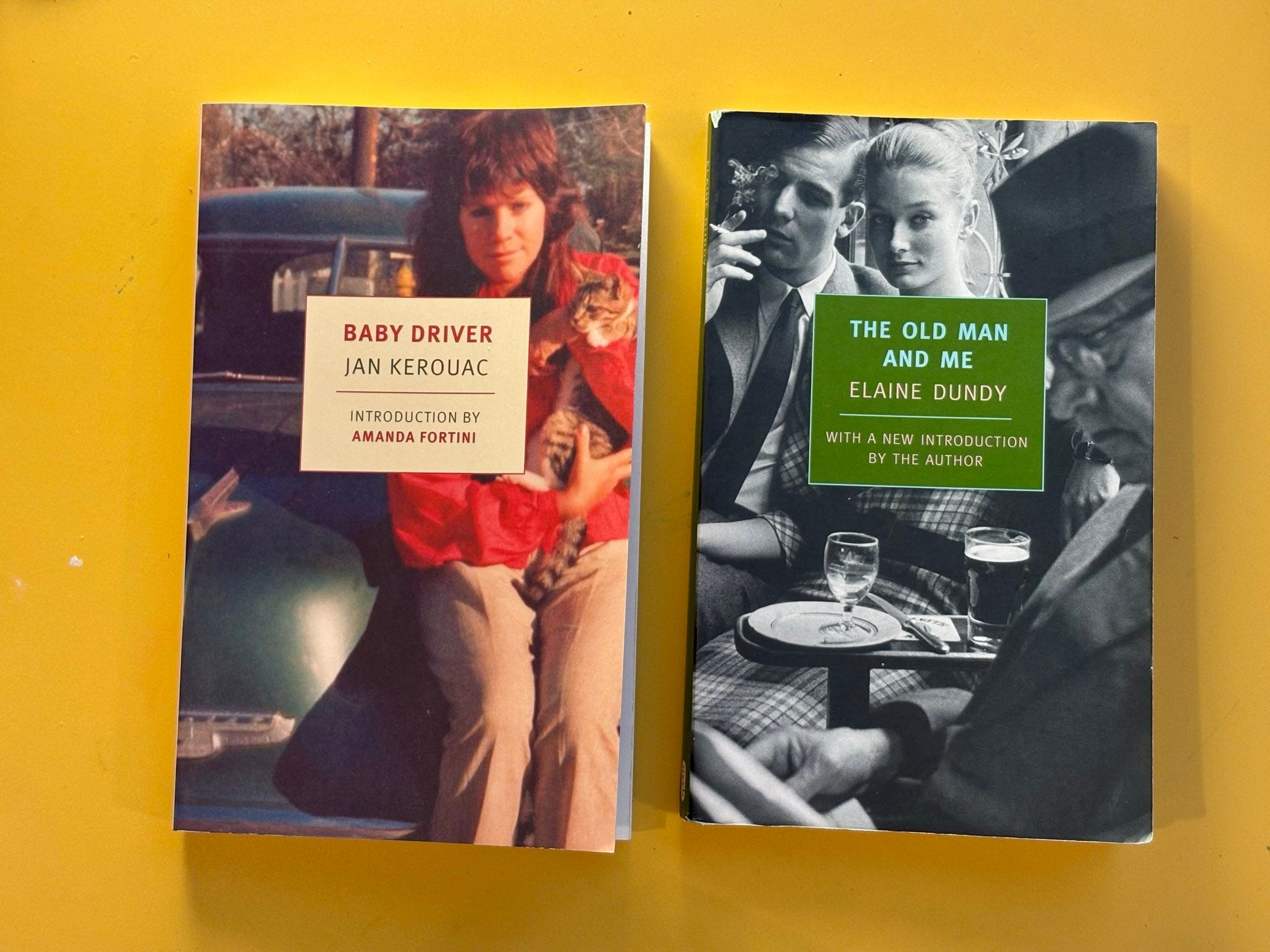
Baby Driver by Jan Kerouac (1981)
(A perfect fit for a reader who hates Jack Kerouac but loves a road trip.)
Jan Kerouac’s Baby Driver, first published as Baby Driver: A Story About Myself, is auto-fiction modeled on her own wild life. The main character has her name, and many details are the same, including the fact that she only met her famous father twice. Both Jans grew up in poverty, left home incredibly young, took drugs and engaged in sex work, were plagued by a parade of insane men, and had free-spirited mothers. It’s unclear where exactly the fiction part comes in.
Jan wrote unflinchingly about her early-onset adulthood. (At age 12 she takes LSD for the first time; at age 15 she is living with her boyfriend in Mexico, where she has a stillbirth.) The book jumps back to her wanderings through Washington, New Mexico, Arizona, South America, and New York. Jan is deadpan and succinct— it’s no pity party. Comparisons with her father are natural, and both of them are poetic, but Jan’s adventures are no dreamy road trip: she is incisive and brutal.
Near the end of the book, she describes “Jan” traveling to meet her father Jack in Lowell— he is watching Beverly Hillbillies with a bottle of whisky, cradling “his giant baby bottle, rocking himself as if in a cradle,” with his wife and mother both nearby. It’s not a flattering portrait. She tells him she’s about to run off to Mexico to avoid being sent to a home for unwed mothers.
John told him we were on our way to Mexico, and I added that we had wanted to see him before we left, because we might be gone for a while. To which he replied, surprisingly, “Yeah, you go to Mexico an’ write a book. You can use my name.”
This, his blue eyes and dark hair, and the minimum child support payments are pretty much the only Jan gets from him. (Both book and author Jan met him for the first time as a nine-year-old, when her mother sought him out for child support; after a court-ordered blood test proved his paternity, he started sending checks but disavowed her, apparently on his mother’s urging.) In Baby Driver, after Jan hears about his death on the radio, she reflects that both he and her stillborn baby “had been half-formed, then lost.” In Eric Vanderwall’s On the Seawall review of the book, which was reissued by NYRB Classics in 2025, he notes that she is both incredibly sensitive (near the beginning of the book, she sweetly describes the a tap-dancing spider who frequents her house) and at the same time oddly removed from the hardships she lives through:
Jan, as a character in Baby Driver, thus comes across as acutely sensitive, which brings into even starker relief the almost casual accounts of harrowing experiences, what Fortini in the introduction describes as a “shrewd, clinical detachment.”
From the beginning, Jan (“Jan”?) endures a lot. The sheer lot of her tribulations make the book painful to take in at times, especially given this detachment that both Vanderwall and Fortini mention. Childhood abuse at the hands of a daycare, for example, is described in a terse sentence: “Terrible things went on there that for some reason I thought I couldn’t tell my mother.” Abuse from men and strangers is addressed similarly. The tradeoff for her carefree, careless, peripatetic life is apparent self-removal. She quickly dismisses trials like her father’s rejection of her, her stillbirth, etc, but we see her careening away from them and how impossible that self-removal is.
Jan (author Jan) wrote two other autobiographical novels and died at 44.
The Old Man and Me by Elaine Dundy (1964)
(Pairs well with a cocktail and a hatred of the English.)
A young, broke American woman runs off to London, a tale as old as time in ages past…with more favorable exchange rates... Under the fake name of Honey Flood, the anti-heroine of The Old Man and Me seems to be pursuing a good time despite an England antagonistic to the Young American and despite the fact that she hates England quite a lot. A secret agenda? Yes, thank god, because the first 100 pages are kind of slow and baffling, but the pay-off is immense. Specifically, “Honey” is pursuing an old man named C.D. (or Seedy, as she starts to call his alter-ego). She wants him, despite his age and their incompatibility. But why?
Compared with the slim, hard-bodied young men his figure was a joke—round, tubby, pillow-paunchy, it had the consistency of foam rubber; rolling around with him was like rolling around with some big beach toy. But he flung himself into it with a devotion that was disarming. A tyrant on his feet, he turned out to be a real woman-worshipper in the sack. And subtle too. And full of tricks. He knew a trick or two, that one. And then it turned out I knew a trick or two I didn’t even know I knew. He could play a whole jazz concert on me. When we were finished we were covered, absolutely covered with each other. And yet I was never surprised at finding myself, six or seven hours later and in my own bed, in real trouble, seized with a shuddery revulsion of shame and disgust. How could I have? All those things. And with that fat old monster? And on top of everything—who was using whom? The original idea had been to enslave him for ever with my womanly wiles but rather the opposite seemed to be happening. For in spite of those sixth- and seventh-hour shudderings at the ghastly unnaturalness of the liaison, in spite of the painfully sharp recollections of my slender, delicate, gloriously young body stretched out alongside his vast old bulk—I am still at a loss to explain it—but in spite of all this—not once was I able to resist him in the flesh.
Ah, an unsuitable love affair. Excellent perversity.
The Runaway Bunny (1942)
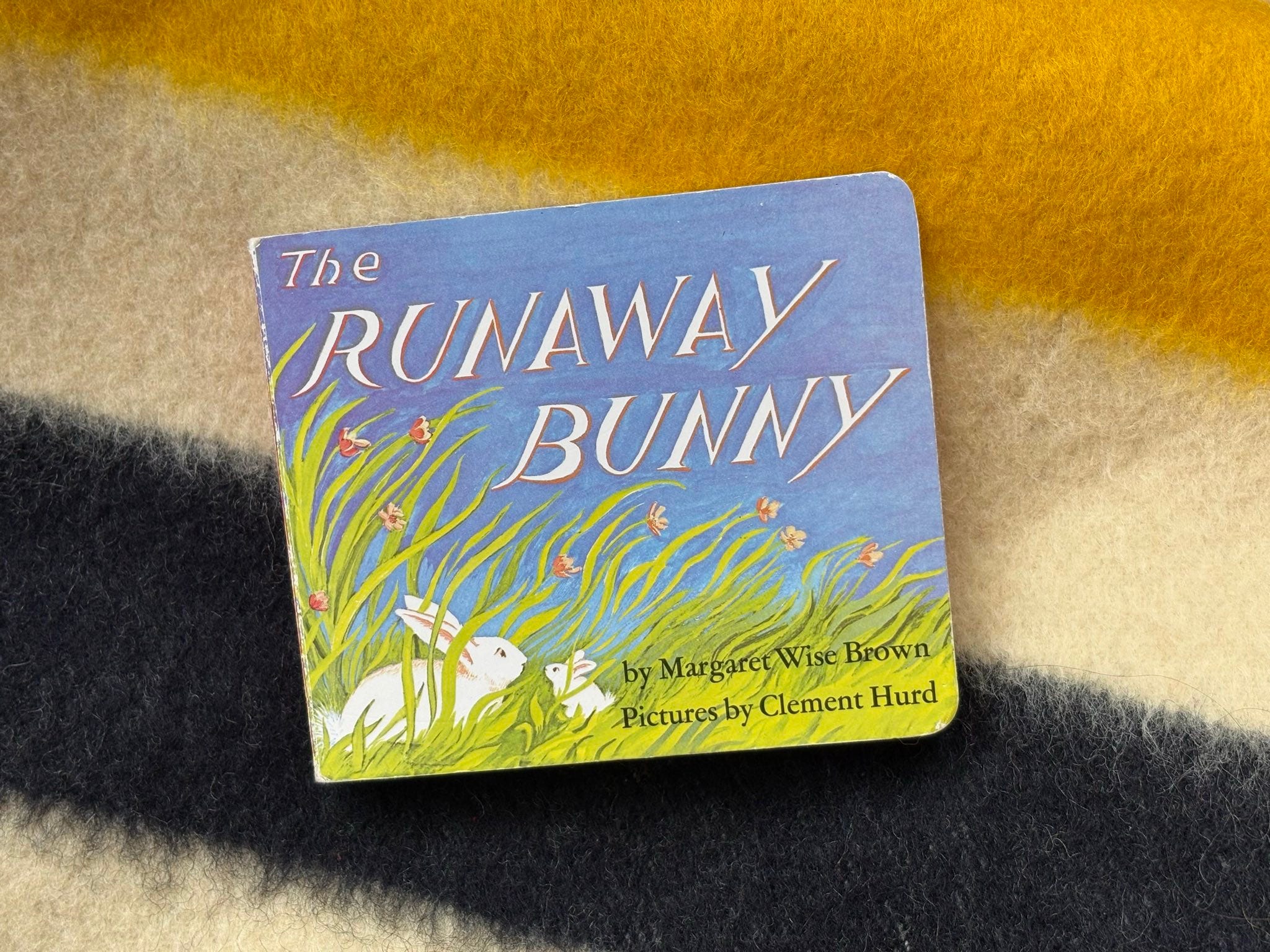
“If you run away, I will run after you. For you are my little bunny.”
At first, I found this book tedious. I’ve read it about two hundred times or more, so I can safely say my thoughts on it have evolved. My son would demand it ad infinitum, but after about 10 readings or so I would hide it in the couch cushions and pretend I’d lost it. (He doesn’t buy it, because he is Too Smart for His Own Good.)
Initially, I thought, what an annoying and somewhat psychotic book. (For those who need to be brushed up on plot: the Runaway Bunny informs his mama that he is going to run away; but everywhere he says he’s going to go, she says she will be too, i.e. if Bunny joins the circus to fly away on a flying trapeze, his mama will be a tightrope walker.) “Attachment issues, hello!!” is what I thought. But after the fiftieth reading or so, I began to thaw. Slowly, I became moved by it. I began to tear up reading it, and now my son actually hides it from me to prevent my inevitable meltdown when I read it.
Maybe it was the proximity of the Rob Reiner news. And then the murders of devoted parents by ICE that have been on my mind: Renee Good in Minneapolis just last week and Silverio Villegas González in Chicago in 2025. I now ache for the Runaway Bunny’s mama. And for Runaway Bunny for wanting to be free.
Okay, not so much The Runaway Bunny.