
BOOK BLOG #1
The problem of organizing your books, the problem of organizing your life... if you think too much it all unravels. MUSINGS + 3 fiction recs

IN THE STACKS
For many years I have been searching for a way to organize my books and to organize my thinking about books.
The physical problem: Currently there is no real organization. I buy a huge number of books, but I try to discard or pass on things I didn’t love or wouldn’t want to read again. I have a to-read bookcase by my bed. Otherwise, things are grouped haphazardly on 6+ (some books are in boxes) bookcases.
The metaphysical problem: How to track what I’ve read? And what I think about it? How simply to remember what I’ve read and what I thought about it?
Of course, as I get older now I feel this need to organize even more urgently as the impossibility of the endeavor grows. (Baby-induced brain rot, less room in the filing cabinet of the brain, etc.)
Goodreads? Off-brand Goodreads? Social media? These are current suggestions which I reject, in short. I need to organize my brain in a way that does not make me feel the need to try to back-fill in everything I have ever read. And something about the quantifying and the comparing and the social media of it all makes me feel icky. Plus I’m trying to get away from my infernal handheld device.
I’m interested in people’s thoughts, but instead of trying to fix this big systemic problem I have, I wanted to write about three books I’ve read recently and recommend.
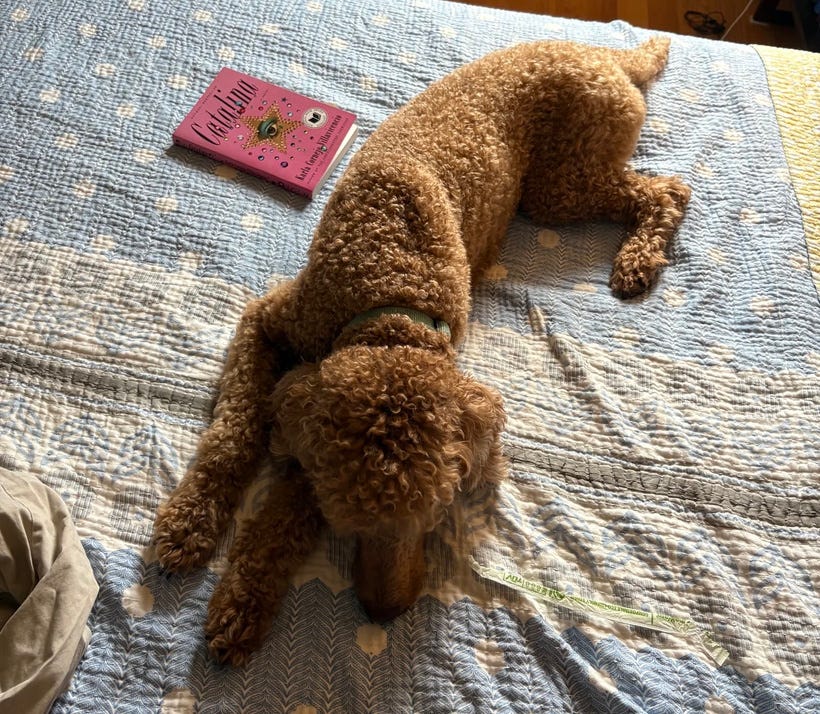
Catalina by Karla Cornejo Villavicencio (2024)
This book should have been a stand-up monologue. It has so much voice, so much character, and so many random hilarious and sometimes contradictory asides that would perhaps work better verbally than they do via text.
The book follows an undocumented Harvard student who takes in the insane and quite routine levels of privilege of her fellow students with a gimlet eye. Catalina is frozen by the fact that although she has made it to perhaps the most elite institution in the country, because of her immigration status, she won’t be able to work legally after graduating.
She has the classic problem without which no rom-coms would be made: misunderstandings abound, perpetuated by a lack of communication. A little communication would have moved the plot along pleasantly. But that’s not the point—Catalina’s fear that she will confide in the wrong person about her immigration status is chilling to her own plot in a very expressive way. She is stuck because her place in the country is stuck, untenable. Only in the very last pages of this book can we breathe and feel some comfort that Catalina does get through this period.
The book does a good job of placing Catalina in the moment: she is a DREAMer while the Dream Act is being debated in Congress during Obama’s second term. She is acutely aware that as she tries to live her life, her very existence and livelihood are being debated by politicians. Her anxiety about being deported is constant, and yet she remains darkly humorous and sharp.
This book is prescient of the moment we are living in now where people are self-deporting rather than face the cruelty of the immigration system: the anxiety of potential detention is an unbearable weight that is borne by people every day.
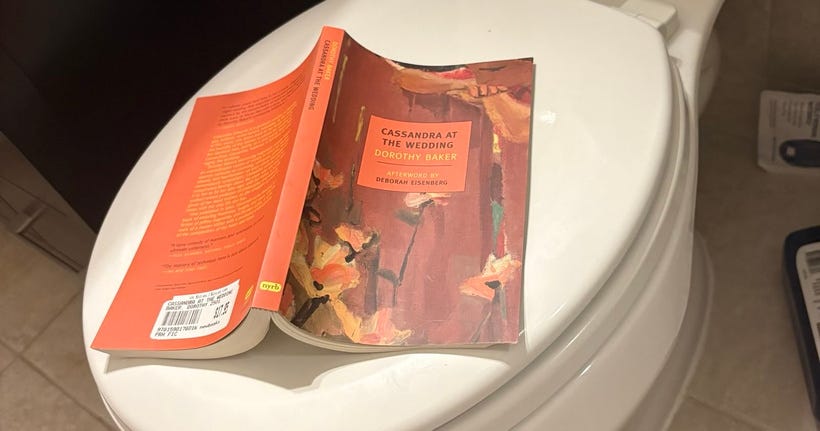
Cassandra at the Wedding by Dorothy Baker (1962)
Books about women going mad = one of the best genres and Cassandra at the Wedding probes the attractive idea that a woman can engage in some temporary insanity seemingly without any long-term side effects. Perhaps it’s even a necessary step sometimes, like when facing your identical twin’s impending nuptials to a perfect doctor when you assumed that the two of you would be living together in sisterly harmony forever.
The oft-repeated axiom about reading is the thrill of recognition you feel when faced with a character who is feeling something you yourself thought nobody else had ever felt. More than that, I think Cassandra at the Wedding confronts you with an uneasy recognition of feelings that are both deeply held and totally mysterious, confusing, and inarticulable. That is what I loved about this book.
The crux of the plot is Cassandra, a graduate student at Berkeley, is driving home to her family’s ranch in the Sierras to attend the wedding of her identical twin, Judith. The cast of characters is extremely small (the twins, the twin’s father and grandmother, and Judith’s doctor fiancé) but those off-stage (the twins’ dead mother, Cassandra’s psychoanalyst who she might be in love with) loom large. As the book goes on, Cassandra, openly hostile, witty, and powerful, descends into madness as she tries to convince her sister not to marry.
I’ll also just shout out the New York Review of Books Classics, which is their reprint series, of which Cassandra at the Wedding is a part. McNally Jackson also has an extremely excellent one called McNally Editions and I have loved every one I’ve read.
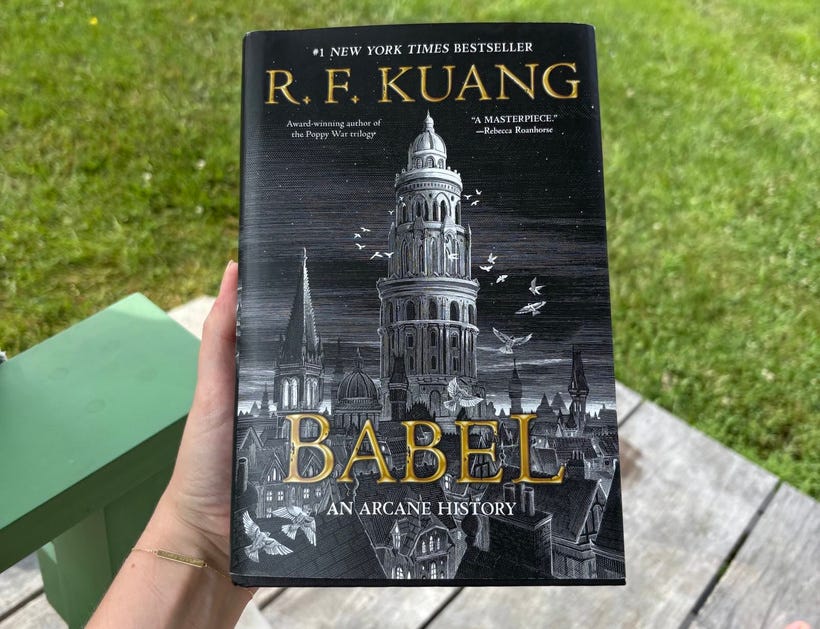
Babel by R.F. Kuang (2022)
I very rarely read fantasy or fantasy-adjacent books. Babel, by the prolific and rather amazing R.F. Kuang, who just popped out another book, was very, very good. It’s a privilege to read something so sustained (ahem, 544 pages) that really sucks you in. It reminds me of an earlier era of reading where I had the time and drive to read for hours straight. (And now I do admit I tend to gravitate, for logistical reasons, to shorter books. I’m glad I gave this one a try anyway—on the recommendation of multiple friends.)
Babel focuses on the experience of a student in 1836 Oxford in an alternate reality where silver is an energy source that is activated by linguists. Our hero Robin is a gifted young Chinese boy who is brought to England in order to be a scholar of linguistics and thus take part in creating the silver bars that power Britain’s economy and colonial empire.
The Oxford novel, for reasons of nostalgia, is a favorite of mine. And yet, during my college year that I spent abroad there I saw the worst bits of the place too: the snobbishness, the racism, the class warfare. Babel was an antidote to the monoculture depicted in the Brideshead Revisited kind of Oxford novel. The Oxford novel is about friendship at its heart, and Babel maintains that concern and complicates it: Robin is one of only four in his year studying linguistics at Oxford’s Royal Institute of Translation and forms intense bonds with his three classmates. They are in different ways all outsiders too, struggling to fit in while they engage in powering Britain’s worst colonial impulses. Kuang reminds us powerfully of the evils of empire as she depicts the four friends coming to political consciousness. It's a moralistic novel but masterfully avoids the tedium of moralizing.
Thanks for reading my first post! Etc.
Eva